Scrum Guide and Expansion Pack: Relevance and limits in systems engineering
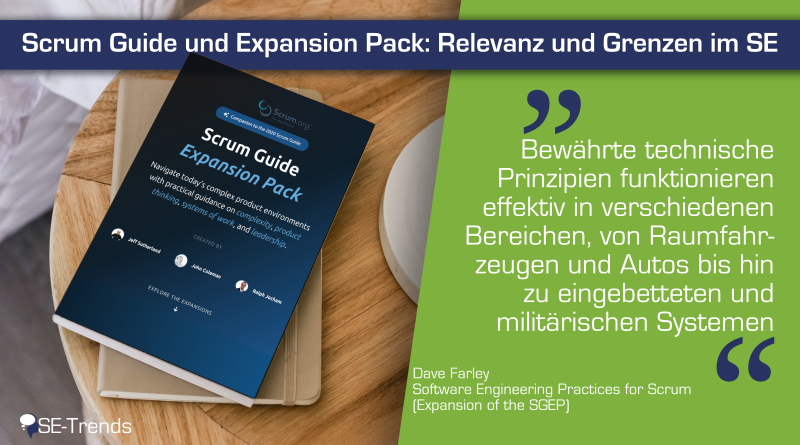
The Scrum Guide has been the reference framework for Scrum for years and has shaped agile product development. With the Scrum Guide Expansion Pack, a supplementary collection is now available that goes into greater depth on key topics such as strategy, product thinking and organization. For systems engineering in particular, this raises the question of whether and how this expansion will be relevant beyond the traditional software context.
Why the Scrum Guide alone is no longer enough
The Scrum Guide defines Scrum in a deliberately minimalist and abstract way and limits itself to the necessary elements of the framework. This reduction creates clarity and prevents methodological overload, but leaves many context-dependent questions unanswered.
Anyone who develops complex, interdisciplinary products therefore quickly comes up against issues such as strategic embedding, end-to-end product responsibility, technical excellence and organizational decision-making logic that the guide does not cover. It is precisely at this interface between the framework and actual product responsibility that many questions arise.
What is the Scrum Guide Expansion Pack?
The Scrum Guide Expansion Pack supplements the official Scrum Guide with more in-depth topics without changing its normative definition. It is intended as a contextualized extension that makes explicit the background, interdependencies and organizational requirements that are deliberately left open in the guide.
In terms of content, the Expansion Pack bundles contributions on strategy, product thinking, engineering practices, organizational design and understanding complexity. The aim is to make Scrum compatible not only as a team framework, but also as a component of modern, adaptive product development systems. It consists of 11 parts:
- Adaptive Executive section: Highlights the role of leadership and governance in adaptive organizations and discusses models such as Beyond Budgeting or Humanocracy as a framework for effective Scrum. The added value lies in the combination of empiricism and decision-making rights at management level, especially in dynamic markets.
- Strategy: Anchors Scrum in a strategic context and shows how strategic intent provides orientation without dictating operational decisions. Relevant for organizations that want to manage outcomes instead of mere output metrics.
- Product Thinking: Shifts the focus from feature output to outcome and impact and explains the logic of value flows over the entire product life cycle. Particularly valuable for product owners and product managers with long-term responsibility for results.
- Software Engineering Practices: Describes technical principles and practices that ensure adaptivity, feedback speed and sustainability. The area of application lies in professional, learning-oriented product development with high quality standards.
- Holistic Testing: Introduces a holistic quality model that integrates testing across the entire development cycle. It addresses teams that understand quality not as a phase, but as a continuous responsibility.
- Psychological Safety: Analyzes psychological safety as a prerequisite for real transparency, inspection and adaptation. Particularly relevant for teams that want to systematically strengthen learning ability and performance.
- Operating Model: Distinguishes between predictive and adaptive organizational models and shows how governance and decision rights influence value flow. The benefit lies in the structural embedding of Scrum in larger organizations.
- Multi-Team Scrum: Provides guidelines for several Scrum teams working on a product with a common goal, backlog and quality definition. Applicable in growing product organizations with a need for scaling.
- Complexity: Uses a cynefin-oriented perspective to distinguish between different problem spaces and derive appropriate courses of action. Helpful for decision-making in complex, emergent environments.
- AI and Scrum: Analyzes the integration of AI into Scrum-based product development and emphasizes empirical control despite exponential technology development. Relevant for organizations that want to responsibly integrate AI into their value chain.
- Scrum on One Page: Summarizes key contents of the Expansion Pack in a compact overview. Serves as a reference and orientation for managers and teams.
Product thinking and value flows
The Expansion Pack shifts the focus from feature output to product responsibility, outcomes and end-to-end value flows. While software value flows are often purely digital and can therefore be synchronized relatively quickly, hardware and software development proceed at different speeds, with different integration and release logics. Particularly in the case of cyber-physical products, this results in structural friction losses that cannot be controlled by additional sprints, but only by consciously designed synchronization and decision-making mechanisms.
- The Scrum Guide: The official definition of a product in Scrum explicitly includes physical products in addition to services or digital offerings. The guide also points out that Scrum has long been used in complex domains beyond software development. The added value lies in the normative clarification that physical product development is not a special case outside the Scrum framework. For hardware organizations, this creates legitimacy to understand Scrum not as an IT method, but as a generic framework for complex product work.
- Product Thinking (Expansion of the SGEP): This section shows that agile product management principles are not limited to IT products, but also apply to industries such as medical technology, healthcare and pharmaceuticals. Practices such as automated quality checks, experiments in small batches and early regulatory involvement serve the same purpose there as in software: risk reduction through rapid learning. The added value lies in the systematic linking of outcome orientation and regulatory reality. For hardware-related products, this creates a bridge between product strategy, validation and compliance.
- Operating Model as a Leadership Decision (Expansion of the SGEP): This shows that even organizations with supposedly stable product lines, such as utilities or traditional manufacturers, are increasingly exposed to dynamic technological and regulatory changes. The decisive factor is therefore not only the type of product, but also the speed of external changes. The added value lies in the distinction between predictive and adaptive operating models and their effects on decision-making rights, financing and value flow. For hardware companies, this means that agile practices only work if governance and organizational structure are also adaptive.
- Software Engineering Practices for Scrum (Expansion of the SGEP): Despite the name, this is also about hardware. The engineering principles described have been applied not only in web or app environments, but also in safety-critical systems, aerospace, embedded systems, automotive and military systems. The focus is on adaptivity, fast feedback, transparency about system states and sustainable quality. The added value lies in combining empirical work with technical discipline. For hardware products with a high level of integration effort, this makes it clear that incremental learning is also possible in regulated or safety-critical contexts.
Practical application in systems engineering
For systems engineers, the Expansion Pack provides a framework for systematically linking architectural decisions, integration strategies and validation logics to strategic objectives. It sharpens the link between technical excellence, empirical learning and organizational decision-making structures by considering engineering practices and operating model issues as an interrelated system rather than separately.
In practical use, the Expansion Pack acts less as an additional method and more as a structuring aid to thinking and reflection. It helps to consciously align product goals, quality definitions, complexity assumptions and governance before new rituals, role models or scaling mechanisms are introduced.
Conclusion
The Scrum Guide remains the normative foundation of Scrum . Its strength lies in clarity, reduction and deliberate minimalism; the Scrum Guide Expansion Pack complements this clarity with context, technical depth and strategic connectivity. .
This is directly relevant for systems engineering. Complex, interdisciplinary product development requires strategic orientation, integrated quality assurance, a conscious approach to complexity and an operating model that actually enables learning. The Expansion Pack does not provide a recipe for this, but a consistent system of thought that makes connections visible and clarifies decision-making logic.
In combination with the Expansion Pack, the Guide is therefore also a useful addition to Product Velocity. While Product Velocity with the Velocity Loop makes the structural link between business, system stewardship, engineering and delivery in complex development visible, the Scrum Guide and Expansion Pack provide concrete tactics and solution approaches for bottlenecks, conflicting goals and structural problems in the respective context.