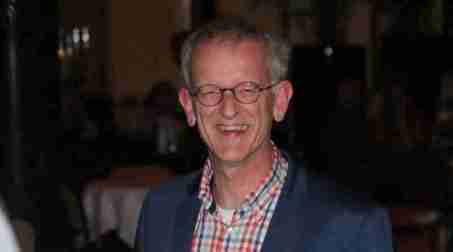
Quo vadis, systems engineering? Keynote speech by Paul Schreinemakers at JamaCon 2019

Last week, JamaCon 2019 took place in Amsterdam, and the keynote of the event was given by Paul Schreinemakers, Director of INCOSE Europe. He spoke about the success of SE, but also the challenges of today and what this means for the future of systems engineering.
Almost exactly three years ago I spoke to Paul at the Day of Systems Engineering (TdSE). Even back then, he saw training as an important task to put systems engineering of the future on a solid foundation. At this year's JamaCon he described his vision of the future of systems engineering, also touching on the subject of training.
The good old days
There was a time when Systems Engineering seemed comparatively simple - at least from today's view. The waterfall was quickly discarded, and the V-model became established relatively quickly. the V-model became established.
It used to be a greenfield environment...
But the traditional approach no longer works: once development has progressed to the point that validation can take place at the top level ("top right"), development has development has taken too long, and it is too late for many meaningful meaningful adaptations.
V&V has to be done early and often
Validation and verification must therefore take place earlier and more often. There are many examples that show the dramatic consequences of not doing this. Paul mentioned the Juliana Bridge (Alphen a/d Rijn), as well as the Boeing 737 MAX.
The speed of development is increasing rapidly
The development times for products continue to accelerate. While the development of a network (of any kind) can take decades, the further development of development of software systems takes place in monthly or even daily steps. take place.
But that's not all: the further development is shifting further into operation: self-adapting systems systems update themselves every second or even microsecond. The context in which modern systems are embedded is no longer clearly defined and non-deterministic.
...now we operate in a brownfield environment
The Future State of Systems Engineering
Paul is actively addressing this issue and is working actively within the framework of the INCOSE on this problem. The current position is published under the name Future State of Systems Engineering in the Systems Engineering Vision 2025 recorded in chapter 3. Incidentally, this will soon be updated for 2035.
One of the findings is that complexity is currently exploding. That is why there are concrete attempts, to slow this down, for example by reducing the size of the software codebase. is reduced. Incidentally, an important driver of complexity is the increasing number of stakeholders. This in turn shows how important the human component is in systems engineering is.
Doctors and patients are stakeholders in autonomous vehicles because they are orders of magnitude safer than today's cars, which is why there will be fewer organs to donate
For the future these developments mean that we should include the basics of systems thinking in the regular school curriculum. curriculum of schools. At the same time, the F4SE (Foundations for Systems Engineering) working group is working on establishing and of SE and teaching it.
If you would like to find out more about the future of systems engineering or would like to get involved with the vision of systems engineering, you can contact INCOSE or, even better, get involved directly. Many of INCOSE's activities are led by volunteers and many of the results are produced by passionate experts. Now is the right time to get involved.