Prof. Dr. Sören Auer: Why knowledge graphs and AI now belong in engineering
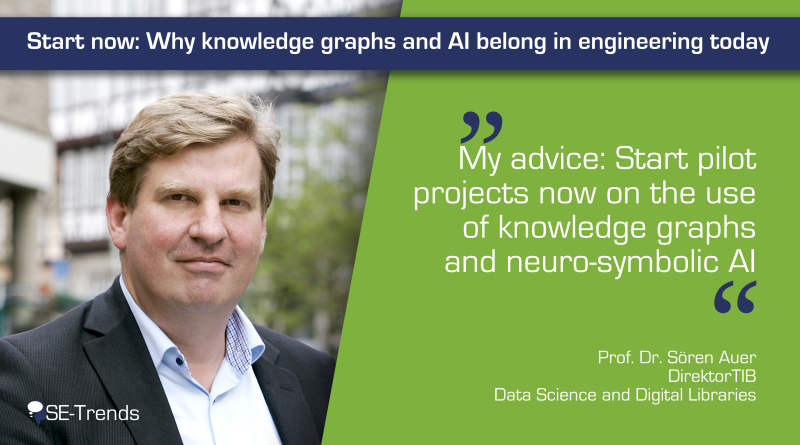
The keynote speech at the Automotive Days on November 4-5 in Munich will be given by Prof. Dr. Sören Auer on the topic of generative AI with knowledge graphs. Reason enough to catch up with Prof. Auer before the event. The following interview was conducted in writing on September 29, 2025.
Automotive Days
The Automotive Days are organized every year by Sodius-Willert. Similar to the MESConfIt is a mixture of "boutique conference" and barcamp. The participation fee is so low that it can be classified more as a nominal fee. With around 100 participants, it is big enough to look beyond your own nose, but small enough to have an intensive exchange with the participants. More info & registration >>
Deal: I have a contingent of 5 early bird tickets (save €90). Please contact me directly if you are interested: First come, first serve!
So if you would like to experience Prof. Auer live in a keynote speech, you should attend the event on September 29, 2025 in Munich.
Research focus at Leibniz Universität Hannover / TIB
My research focus is in the field of data management, neuro-symbolic AI, semantic technologies and knowledge graphs. At Leibniz Universität Hannover and the TIB we are working on how knowledge can be represented and used in the form of networked, machine-interpretable structures. This involves not only basic research, but also the development of specific tools with which companies and researchers can link, analyze and utilize data more effectively.
Topics such as knowledge representation, AI-supported information search, retrieval augmented generation (RAG) and systems engineering form the core of my research.
Prof. Sören Auer
Practical relevance for the development of complex physical products
The development of modern products - whether vehicles, machines or complex structures - is a prime example of system-of-systems engineering: many disciplines, components and data sources have to be integrated. Our approaches help to Enormous complexity to master. Knowledge graphs can be used to network development data across departmental boundaries, making dependencies transparent and risks visible at an early stage. In combination with AI methods, engineers can better validate design decisions, Variants faster and reuse knowledge from previous projects. In short:
We provide the methodological basis for companies to make their development processes more robust, efficient and innovative.
Prof. Sören Auer
Relevance for the transformation of the automotive industry & potential of knowledge graphs / RAG
The automotive industry is facing a double transformation: electrification and digitalization. This means that complexity is increasing enormously - software, electronics and mechanics are growing ever closer together. This is where our fields of research come directly into play:
Short term can use knowledge graphs and RAG technologies Resolve data islands. For example, in requirements documentation, variant management or regulatory specifications. Engineers save time when searching for information and avoid errors because they have context-related knowledge directly available in the work process.
Long-term This results in intelligent engineering assistance systems that actively support system architects or developers, not only in finding, but also in understanding and optimizing complex interrelationships. This allows transformation projects to be accelerated, quality problems to be reduced and innovation cycles to be shortened. For the automotive industry in particular, this can make the decisive difference in not only keeping pace with global competition, but also taking on a pioneering role.
Status of industry & start-ups in the field of knowledge graphs and RAG
We are observing that the topic is gaining momentum in the industry. Many companies have launched pilot projects, but often there is still no end-to-end strategy for systematically using knowledge graphs and AI in engineering. It is exciting that start-ups are focusing precisely on this gap:
- Spread AI for example, is working on the intelligent analysis and linking of engineering data.
- Raiqon AI in turn relies on AI-supported information access for highly specialized business areas, particularly in the field of requirements engineering.
- With our spin-off eccenca we have developed a platform (Corporate Memory) for the networking of company data, information and knowledge for the automation of complex decision-making processes, which is now being used by a large number of companies.
These examples show that a dynamic ecosystem is emerging here that established companies should urgently keep an eye on.
Looking to the future - developments & recommendations
I anticipate three key developments over the next five years:
- Increasing standardization and establishment of knowledge graphs in the industry: Companies will increasingly rely on shared data models to break down silos.
- Integration of AI in engineering workflows: Retrieval augmented generation and extensions such as knowledge augumented generation will no longer be pilot projects, but will naturally be embedded in tools such as PLM or requirements management systems.
- Intelligent assistance systems for system architects make AI the "second layer of thinking" in engineering: A tool that explains complex dependencies, calculates scenarios and provides decision-making certainty.
My recommendation to system architects and decision-makers
Start now with pilot projects for the use of knowledge graphs and neuro-symbolic AI in defined areas, such as requirements analysis or variant management. This will allow you to create organizational and technical experience. At the same time, you should develop a data strategy that takes knowledge graphs and AI into account from the outset. This is the only way to make the transformation a lasting success.