Traceability can never start too early: Pre-Requirements Specification Traceability
Traceability in requirements management and systems engineering is now a well-understood topic. But do we have traceability for what happens "before"? This refers to traceability to interviews, meeting minutes or legacy systems. This traceability becomes more important as complexity increases. In this respect, I found the recently published meta-study by Julia Mucha, Andreas Kaufmann and Dirk Riehle on this topic exciting. Below is a summary of the most interesting results.
The paper
From the paper with the title A systematic literature review of pre-requirements specification traceability was published this year by Springer and can be downloaded free of charge from the Website of Dirk Riehle can be downloaded. The authors note that comparatively little research results can be found on pre-requirements specification traceability (pre-RS).
As the title indicates, this is a literature review of 77 publications.
A colorful bunch of sources
Everything on which the requirements specification is based is a source for which we want to create the traceability. This often includes texts, but increasingly also audio and video recordings, photos (e.g. of whiteboards) and much more. Accordingly, the effort required to create and maintain this traceability is significantly higher than post-requirements specification traceability (post-RS). In practice, this is therefore primarily created for the purpose of compliance. Unfortunately, this means that many of the advantages of traceability are lost.
Questions
This study systematically examines three questions. First, the authors investigated the benefits of pre-RS (and which use cases exist at all). This is not as obvious as it might seem.
Even though it is obvious that pre-RS traceability has many challenges, the authors investigated what exactly these are. They also examined solutions already in use today.
Finally, the authors looked at specific techniques. A technique is not the same as a solution. The authors also identified gaps here.
In order to quantify the results of this qualitative study, the authors used a technique developed by Corbin and Strauss in which text passages were coded according to concept (code) and assignment (coding). The authors found a total of 1,143 codings, which were later used to find relevance.
Let's now look at the three questions in detail:
What are the use cases and benefits of Pre-Requirements Specification Traceability?
The authors identified a total of 13 use cases for pre-RS and prioritized them via the codings. By far in first place was the Search for the sourceto support understanding. Second place was shared by Find responsible persons and Fulfill compliance. The complete list is shown in Table 5 of the paper.
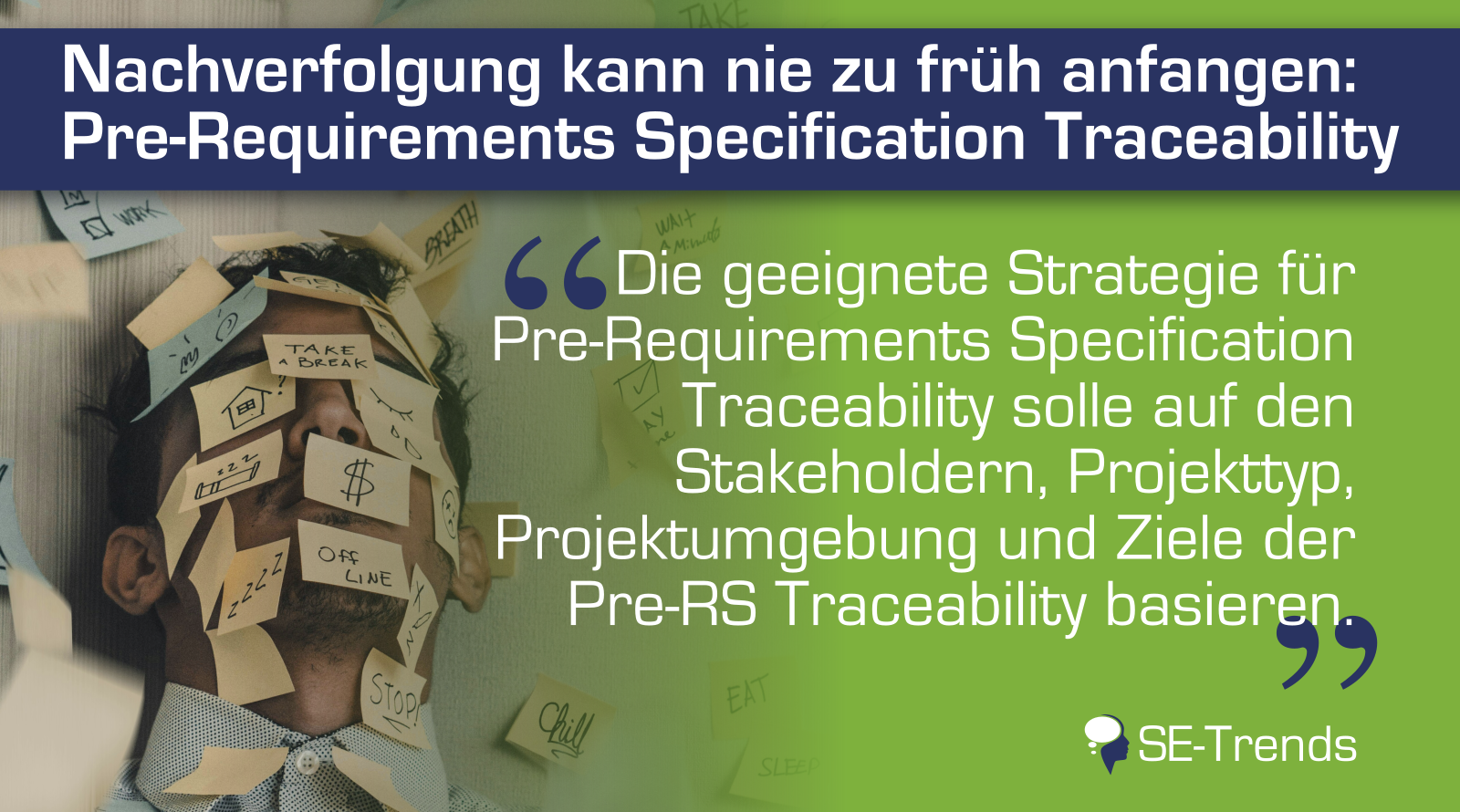
The appropriate strategy for pre-requirements specification traceability should be based on the stakeholders, project type, project environment and objectives of pre-RS traceability.
A systematic literature review of pre-requirements specification traceabilityChapter 5.3
The authors also identified 6 benefits. In first place was Monitoring and gaining knowledge for future projects. Next came Quality improvement and in third place Reuse of requirements. What these three benefits have in common is that they all relate to the future. This does not apply to the other benefits. The complete list is shown in Table 6 of the paper.
What are the challenges and solutions of Pre-Requirements Specification Traceability?
Wouldn't life be much easier without people? At least the authors identify people as by far the biggest challenge regarding pre-RS, which is not really surprising. This challenge is so great that the authors break it down into six codes. The first sub-problem is to meet the requirements of all stakeholders. Because Stakeholders almost always have conflicting requirements. Further challenges are documentation and maintenance of traceability.
The solution page contains the Trace link in the first place. This refers to the concept of possibly typed relations between an artefact (e.g. a text block or image file) and a requirement in the specification. Simple in principle, complex in practice.
If you want to know more about the solution approaches, you should study Table 8 together with Appendix B, as there are too many subgroups here to simply summarize the results.
What techniques are available for pre-requirements specification traceability?
Techniques include methods and models that often only work with the help of tools.
A technique should cover three aspects. Firstly, it must define what a trace is, i.e. what the source and target consist of and how the trace is typified. Secondly, it must describe when and how traces are recorded. Finally, it must describe how relevant traces are selected in order to support specific use cases.
The authors note that although the maintenance of traceability is rarely mentioned in the literature, it must be an important part of the techniques in any case. After all, outdated traces can not only be useless, but can even cause damage. Trust in traceability is the basis for its usefulness.
The authors identified two classes of techniques. The first are techniques specifically relevant to traceability. In first place is the Keyword-based traceabilityon the second the Person/role-specific traceability. Table 9 shows the complete list.
The second class is about five basic concepts. The first is Model-based development. In second place is Natural Language Processing (NLP). I have already written a lot about both topics in this blog, as well as about Ontologieswhich appear in third place.
Little AI
The authors noted that they Artificial intelligence (AI) as a technology in any of the articles, even though a lot of research is being done in the field of AI. They attributed this to the unreliability or mistrust of AI-generated content.
I wouldn't be surprised if that changes soon.
Open questions
It is particularly exciting for scientists to focus on the gaps. Because there is potential for research there. In this regard, the authors noticed that they had difficulty finding a "common denominator" for pre-requirements specification traceability. Also on the subject of Return on investment the authors see a need for further research. This topic is certainly highly relevant for the industry. The authors have identified three further topics in chapter 6.1.
Conclusion
I can confirm from practical experience that pre-requirements specification traceability is a neglected topic. I can also report from my own experience that pre-RS can make a significant contribution to sharpening the product-market fit. I therefore welcome research such as this and will be happy to draw on this work in the future.
Photo by Luis Villasmil on Unsplash