OpenMBEE: The Long Journey from NASA’s JPL to Kotar

Kotar is a free SysML v2 editor that runs in the browser. My first impression: Extremely impressive. In particular, it’s much more than just an editor—it includes a SysML v2 service, a model management system called Flexo, and an RDF database. For a tool meant for writing a few models, that’s an astonishingly robust set of features.
The explanation lies with NASA's Jet Propulsion Laboratory (JPL). It was there, starting in 2011, that the initial concepts were developed, which later gave rise to the open-source community OpenMBEE. Kotar has been publicly available since October 2026 and makes this technology accessible without the need for server installation. The underlying architecture has a fifteen-year history.
Events on this topic
- November 4, 2026: SysML v2 and Product Velocity: Is Modeling Becoming Part of the Engineering Infrastructure? Webinar with Tim Weilkiens
- February 3–5, 2027: OpenMBEE Workshop,, Caltech, Pasadena, California
System models reach too few people
A system model contains information that is needed far beyond the modeler. Requirements engineering needs the requirements, and developers of adjacent components need the interfaces. Nevertheless, this information remained locked within the respective modeling tool for a long time.
Anyone who didn't have the tool or didn't want to use it was given an export as a document. This resulted in two separate sets of data. Every change to the model required a new document. Comments from reviews were only incorporated into the model if someone entered them manually.
This is where OpenMBEE came in. Initially, the focus was on SysML models from existing tools. The goal was to make these models usable even by people who would never open the tool themselves. That was years before SysML v2.
One Model, Different Approaches
OpenMBEE stands for Open Model-Based Engineering Environment, one of NumFOCUS A sponsored project with an active community and its own SysML subgroup (OpenSysML). The project divides the work into the following three components:
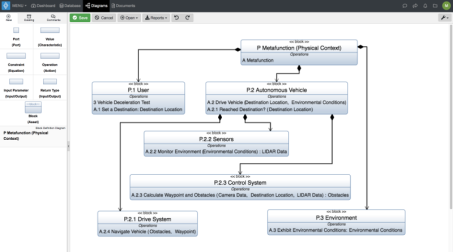
The Model Management System (MMS) stored model information and its versions. The Model Development Kit (MDK) integrated the modeling tool with the MMS. The View Editor displayed model content in the browser. This allowed users who didn't work with SysML on a daily basis to still work with the model information.
A document in the View Editor was not a copy of the model. It referenced elements that were still part of the model. OpenMBEE calls this Transclusion. Even if a requirement appears in three documents, it still exists only once. If the requirement changes, all three documents are updated accordingly. The View Editor Documentation describes the principle and role of MMS as a data source.
Work began a long time ago at JPL. The OpenMBEE Publication List includes articles from 2011 and 2013 on the automatic generation of technical documents from system models, including contributions from co-founders Chris Delp and Robert Karban. In addition to JPL, companies such as Boeing (as an industrial user), Dassault Systèmes (as a tool manufacturer), and LieberLieber (as an engineering consulting and software company) are also active in the OpenMBEE ecosystem.
From Angelyne to Flexo
The Project History covers six generations of infrastructure. The names follow the alphabet:
- 2011, Angelyne: Model information could be edited in the browser and exported as a PDF or HTML file.
- 2013, Bender: Table editing and a repository for model elements were added.
- 2015, Crushinator: The first open-source releases were published. Synchronization between the SysML model, MDK, and MMS was enhanced.
- 2017, Donbot: Branches and tags were added to the model management system.
- 2019, Execubot: MMS was enhanced with graph-based features. The architecture was adapted for SysML v2.
- 2021, Flexo: The infrastructure was migrated to a modular, RDF-based architecture with an eye toward SysML v2.
What began as a tool for incorporating model content into documents gradually evolved into an infrastructure for model management, long before SysML v2 was standardized.
Flexo: The Model as a Graph
With Flexo, the main change was in how data is stored. A SysML model consists of elements and their relationships. A requirement belongs to a package, and an interface connects two components. Together, these relationships form a graph. Flexo stores it in the Resource Description Framework (RDF), a data model for making statements about resources. Ontologies can be built on top of RDF, but RDF itself is not an ontology.
The data is stored in a Quad Store. It stores each statement along with the graph to which it belongs. On top of that, Flexo provides model management with repositories, branches, commits, and diffs. The Flexo Architecture describes these layers and their interfaces.
That sounds like Git, but it works on a different level. Git tracks changes to files. Flexo manages versions of a model graph. SysML v2 text files can apparently be versioned with Git without any problems. However, if you want to know which elements have been added between two model states, with Git you first have to parse the files, include libraries, resolve versions, etc. With Flexo, a tool queries individual elements directly, follows relationships, and requests diffs between model states. That’s why both approaches coexist.
Flexo itself is not tailored to SysML. It manages versioned graph data. The SysML-specific functions provide services that build on top of that.
SysML v2 Opens Up New Possibilities
The OMG adopted SysML v2 in 2025, and the formal specifications were published in September. In addition to the language itself, the package includes KerML as the semantic foundation and a standardized system modeling API. The OMG explicitly treats the three components as a single unit.
Previous integrations depended on the interfaces of individual modeling tools. SysML v2 now specifies how applications can retrieve and modify model elements via an API. It also includes a textual notation. The API and the text refer to the same semantics.
Flexo can serve as the backend for this API. In the current architecture, the SysML v2 service sits as a separate layer on top of the generic model repository. A client interacts with the SysML v2 API and does not need to know that RDF lies beneath it.
This establishes a standard for the long-standing OpenMBEE concept: Many applications access the same model information. Whether this results in a functional engineering process depends on what information the applications exchange and how they handle changes.
The connection through Robert Karban
Robert Karban worked for many years as a systems engineer at JPL, where his work included developing executable SysML models for large-scale engineering systems, such as the Thirty Meter Telescope (TMT), whose The model was released as open source . He co-founded OpenMBEE and contributed to the standardization of SysML v2. Today, he is the CTO of Planetary Utilities, the company behind Kotar and Starforge.
Chris Delp is also one of the founders of OpenMBEE. He leads a systems engineering group at JPL and is listed as an author on early publications regarding document generation from models. The basic idea and large parts of the infrastructure are therefore many years older than Kotar. Both also teach at Caltech.
Johannes Gross, CEO of Planetary Utilities, also has a background in projects at JPL. Karban directly links product development at Planetary Utilities to the OpenMBEE community and the SysML v2 standardization effort. That explains why a Flexo is built into a browser-based editor.
Not only that: Anyone opening Kotar for the first time immediately feels as if they're in VS Code to work. Among other things, this is based on WebAssembly (WASM): This allows powerful development tools to run directly in the browser, similar to how they would in a virtual machine. Once the necessary program components have loaded, these tools can even operate without a constant server connection.
Kotar: A browser-based editor built on this infrastructure
In October 2026, Planetary Utilities Kotar publicly. Kotar edits SysML v2 models both textually and graphically and includes features for navigation, validation, and automation. A local SysML v2 service, Flexo/MMS, and an RDF Quad Store run in the browser.
Users do not need their own server. Models can be edited locally and managed via Git. For larger environments, Planetary Utilities describes how to connect to an external Flexo instance. Git and Flexo have different roles in this process. A GitHub connection does not automatically mean a connection to a shared Flexo repository.
In September 2026, the OpenMBEE team also released the modeling core as open source. The OpenMBEE SysML Toolkit It includes parsers, semantic model processing, validations, and interfaces for Python and WebAssembly. It is licensed under the Apache 2.0 License.
The open-source release of the OpenMBEE SysML v2 modeling core is a real breakthrough. With it, we finally have the foundation to reliably exchange SysML models between different tools and enable true SysML interchange.
Daniel Siegl, LieberLieber Software
Kotar itself is free in the Community Edition, but it is not open source. Planetary Utilities provides the public support repository Of course, the editor's source code will not be released. OpenMBEE, Flexo, and the sysml-toolkit are open source, as is the Mult-Language SDK for SysML v2.
When you open Kotar, you'll see a SysML v2 editor. If you look at the services listed below it, you'll find OpenMBEE.
Conclusion
JPL and NASA have played a key role in shaping modern systems engineering over the decades, for example through the NASA Systems Engineering Handbook. Over the past fifteen years, OpenMBEE has built an infrastructure for accessing model information within that framework. SysML v2 now provides the standardized API, and Kotar makes both available without the need for server installation.
For the evaluation of SysML v2 tools, this implies that notation and diagrams are only the visible half. Just as important is how other applications access the model and whether model elements retain their identity across changes. An editor that only writes files does not solve the problem from 2011. An editor built on a model repository can solve it if the surrounding processes are aligned.
Only time will tell whether this can be used to build end-to-end development workflows. The foundation for this is older than the new browser editor might suggest.