Engineering skills alone are no longer enough: What I discussed in the Heldengeschichten podcast with Dr. Thomas Löbel
I was recently a guest on Dr. Thomas Löbel's podcast Heroic stories. The title of the interview: „Engineering skills alone are no longer enough!“. That sums it up pretty well. German engineering skills are still there, but good technology alone is no longer enough.
I was particularly pleased about the invitation because the podcast fills a gap that often remains open in the German-speaking engineering environment. It's not just about specialist topics, but also about careers, development, attitude and the question of how engineers survive in a world in which technology, organization and the market are moving ever closer together. This is where the most exciting conversations and the most difficult questions arise.
Heldgenschichten Podcast | Episode | On Spotify | At Amazon Music | With Apple Music
Heroic stories
In the Podcast is about careers for engineers. This is evident not only in the formal positioning, but also in the nature of the interviews. Thomas Löbel is not only interested in CVs and career stages, but also asks about decisions, errors in thinking, breaks and experiences that were formative in retrospect. This type of conversation is valuable because technical work is never limited to methods or tools. It always depends on people, biographies, courage, timing and sometimes on very simple questions: What am I actually working on? Why am I doing this? And what value does it really create?.
I am also pleased about such invitations because they reach a different audience than traditional systems engineering formats. Anyone sitting in a specialist conference usually already shares many basic assumptions. In a podcast like this, a broader spectrum often listens: career starters, experienced developers, managers, people at turning points in their careers, perhaps also engineers who sense that their company has come to a structural standstill without yet having a clear language for it. For such listeners, a good conversation is often more valuable than a technical lecture. It opens up a space for thought before it provides a model.
There is a second point. I appreciate formats in which engineering professions are not narrowed down as purely specialist careers. Today, good engineers have to be able to do more than just master their specialist field. They have to deal with uncertainty, understand the logic of the product, bridge interfaces and much more. It is precisely this breadth that the podcast reflects well.
The conversation
The high-altitude conversation with Thomas dealt with a question that has been on my mind for years: Why do many established companies find it so difficult to develop physical products at the speed that is required today? The starting position is not hopeless at all. Germany has outstanding engineers, a deeply rooted quality culture in many industries and experience with complex products and demanding technical domains. The weakness lies in the structures, thinking models and cultural habits with which we organize this expertise.
We have talked about why terms like Agility or Model-Based Systems Engineering are relevant, but are not sufficient in themselves. The great acceleration only occurs when a company rethinks the whole, optimizes value streams instead of departmental boundaries and understands product development as a continuous system.
Many threads can be drawn out of the conversation. Three topics are particularly close to my heart.
To also spread optimism: What do German companies do well that is often underestimated internationally?
The simplest narrative at the moment is: others are faster, so we are doing almost everything wrong. This narrative is convenient, but in reality it is more complex. German companies have strengths that are often underestimated internationally, in particular a deep sense of responsibility for quality. By this I mean the genuine inner aspiration to build a product in such a way that it works reliably, that it is safe, that it can withstand real-life conditions and that you don't have to be ashamed of it. That sounds banal, but it's not. In many industries, this is a hard-earned competitive advantage.
The second strength is the ability to master complex systems in the first place. Many German companies work on vehicles, machines, industrial plants, medical devices or safety-critical components. Mechanics, electronics, software, production, approval, service and operation all have to work together. This integration work is demanding. It is often taken for granted because it has been built up over decades in many companies. In reality, it is an asset.
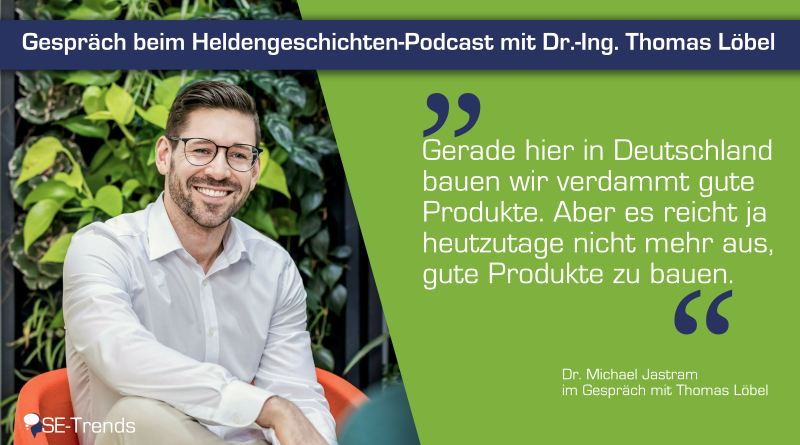
We Germans have really good engineers. We also have a very strong sense of responsibility for quality. And quality is structurally anchored. It's not just slapped on top.
Dr. Michael Jastram
The third strength is sustainability in the best sense of the word. Many products from Germany are not intended to be disposable, but should continue to fulfill their purpose for years to come. At a time when some markets are dominated by rapid iteration and short-lived optimization, this remains a real value. Customers appreciate this. Especially in demanding domains, they appreciate it very much.
The mistake is therefore not that we take quality seriously, but that we treat quality and speed as opposites. As soon as quality is used as a justification for delaying learning and postponing decisions, it loses its value. Good companies create something different. They build quality into their architecture, processes and platforms in such a way that changes become safer instead of more dangerous. Quality then becomes an accelerator rather than a brake.
Career of engineers
A second topic in the podcast was my own career. I originally studied shipbuilding, although my early interest was in computers and software. Later, my path led me to the MIT and then to the USA for around ten years. There I worked in start-ups, developed software, experienced architecture, got to know other speeds and gained a perspective that has strongly influenced my thinking today. Then came my return to Germany, later my doctorate and finally my self-employment.
I am not telling you this because these stages are so extraordinary in themselves, but because there is something in them that I would like to pass on to many readers: a straightforward CV is overrated. Many of the skills that become important later on are the result of detours.
I also think it's a mistake to view a career exclusively as advancement within a given specialist field. Engineers benefit greatly from getting to know neighboring fields. This can be software, but also sales. It can also be research, but not necessarily directly after graduation. I have found that later academic specialization can be very productive because it builds on real practice. You then read problems differently and recognize more quickly what sounds elegant and what works in practice.
For readers who are thinking about their own development, I have three very simple recommendations.
- Take your own curiosity seriously. The subject you start with is not the limit of what you can contribute later.
- Learn early to see value. Not just tasks. Not just deliverables. Not just reports. Ask yourself what contribution your work actually makes to the value chain.
- Never underestimate non-technical skills. Sales, marketing, communication, positioning and clarity in decision-making are not minor issues. They often determine whether good work has an impact or remains invisible.
Highly qualified experts in particular underestimate this last point. Many believe that excellence asserts itself. This is not true. The market does not automatically reward the best solution, but often the clearest, most visible and most connectable solution. This is sometimes unpleasant for engineers, but it remains true.
Product Velocity
The third focus of our discussion was Product Velocity. I use this term because I lack a precise expression for what companies really need in product development today. It's about the ability to get valuable products to market faster and into the hands of customers faster, without collapsing in terms of quality, safety or system understanding.
One point was particularly important to me during the conversation: the V-model is not the enemy. The problem is that our iterations take too long, we integrate too late and we still treat product development as a project with an end date. Project thinking has long been functional for many industries. Today it is a real problem. Modern products don't end with the SOP, they live on and receive updates.
One particularly important step is the platform. This is where thinking changes fundamentally. A platform is not developed once and then managed, but continuously expanded, stabilized and opened up for new value creation. Those who take this step can systematically scale innovation.
Conclusion
I enjoyed the conversation with Thomas Löbel because it did not artificially separate professionalism and life. The two belong together. Product Velocity is not just a technical issue. It is also a cultural issue, a leadership issue and a career issue.
I see no reason for German companies to be fatalistic. I see quality awareness, system competence and a serious engineering culture. What is missing is less ability than change. Away from project thinking and towards platform thinking, architecture for flow and a culture in which responsibility does not end at departmental boundaries.
I see the same opportunity for engineers on a small scale. The future belongs to those who have mastered their field and at the same time understand how products, organizations and markets interact.
That's exactly what we talked about. And that's exactly why this podcast episode was more than just an interview for me. It was a conversation about how good engineering work will remain effective in the years to come.
You can find the podcast in the episode Engineering skills alone are no longer enough! with Dr. Thomas Löbel.