Four perspectives on ontologies between SysML, AI, and philosophy
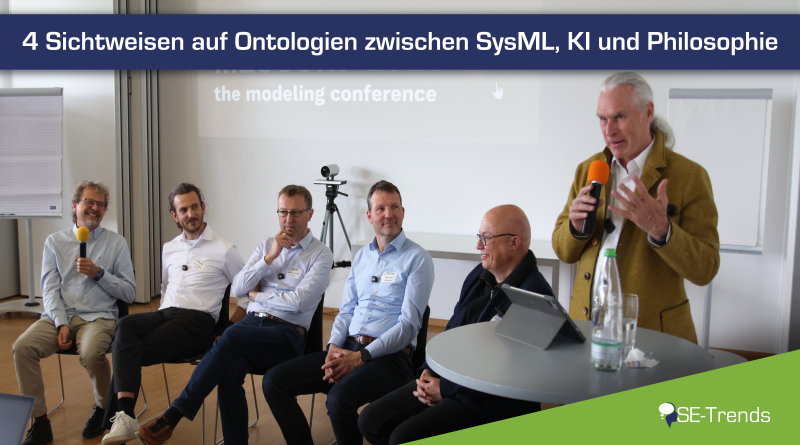
MESCONF 2026 focused on ontologies this year. In the age of AI, these are receiving a lot of attention. Ontologies can help solve a problem that many companies are currently grappling with: How can data, models, tools, and AI systems be connected to create reliable knowledge?
The contributions ranged from knowledge graphs in production systems and semantic architectures for AI to fundamental philosophical questions of being. This mix provided a great introduction to the event, as the term is often used in engineering without a clear understanding of its origin or the different meanings it encompasses.
Below is a summary of the three impulse talks from research, industry, and AI practice, followed by an evening keynote by philosopher Jan Urbich.
The MESCONF: Over Ten Years of System Modeling
The MESCONF was founded quite informally over a few glasses of beer and wine at the ESE congress over ten years ago, with Infineon as the host on the beautiful Campus. The maximum room capacity of 100 people ensures that the event remains personal.

The MESCONF creates an interdisciplinary thinking space for Systems Engineering and Modeling. Accordingly, a large part of the event is shaped by participants in an Open Space format. There will also be expert presentations, an exhibition by sponsors, and the impulse presentations described below, which set the tone on the morning of the first day.
This year's focus on ontologies fit the context well, as they touch upon several current tension points in systems engineering simultaneously, namely modeling, AI, and data integration. And ultimately, they address the question of how different disciplines can arrive at a shared understanding in the first place.
Ontologies in Systems Engineering
In classic systems engineering, large amounts of structured information arise, such as Requirements, architectures, functions, interfaces, tests, variants, software artifacts, operational data, and much more. These are usually distributed across numerous tools and departments. Each tool has its own data models, and each discipline uses its own language. Even seemingly simple terms like „component“ or „interface“ have different meanings depending on the context. This is precisely where ontologies come in.
One Ontology describes concepts and their relationships in a formally comprehensible way. The goals are data consistency and a shared semantic understanding. Ontologies thus make it possible to make connections machine-readable. They create structure for knowledge graphs and enable logical conclusions across tool and domain boundaries.
This topic becomes particularly relevant with generative AI. Large language models produce impressively good answers. However, they lack a stable understanding of technical contexts. Ontologies provide precisely this missing context. They explicitly define terms, relationships, and constraints. This creates a controllable knowledge base that can secure AI systems.
The three impulse lectures and the keynote focused precisely on this connection between modeling, knowledge graphs, and AI.
Lecture: Ontologies as a communication system between data spaces
The introduction was provided by Prof. Dr. Steffen Staab with his presentation on ontologies for system communication.
The focus was on the observation that modern systems consist of many independent data spaces. For example, in a factory for durable products, new information about the production, use, maintenance, or remanufacturing of individual components is continuously generated. This data changes permanently. At the same time, it must remain interpretable over long periods.
Similar problems arise in construction. Different disciplines work with their own tools and terminologies. Nevertheless, information must remain consistently transferable across disciplines.
Staab argued that classical, rigidly defined data models are no longer sufficient for such scenarios. The structures change too quickly and new requirements constantly arise. Ontologies enable a flexible semantic description of the involved terms and relationships.
Ontologies provide us with a language to describe concepts relatively consistently over long periods, even though systems, data, and applications are constantly changing.
Prof. Dr. Steffen Staab, MESConf 2026
Particularly interesting was the classification of ontologies in the larger context of semantic web. Staab showed the known layered structure of technical standards up to formal knowledge models and inference mechanisms. Ontologies appear within this as part of a larger ecosystem of formal meaning models.
Also the connection to SysML was explicitly discussed. Staab emphasized that SysML and ontologies have many similarities but focus on different aspects. SysML strongly describes the behavior and processes of a system. Ontologies concentrate more on terms, meanings, and formal relationships. At the same time, SysML still lacks a standardized formal logic layer for reasoning.
Particularly relevant for current AI discussions was the reference to so-called KG-RAG approaches, when language models are combined with knowledge graphs. Ontologies serve as a structuring basis for reliable answers. This increasingly shifts the role of ontologies towards a potential infrastructure technology for industrial AI.
2. Lecture: Ontologies as an Antidote to Hallucinations
The lecture by Alexander Krumm directly tied into this AI perspective but focused much more strongly on practical risks.
Krumm formulated a provocative thesis: Pure data linkages are not sufficient for reliable AI in engineering. Systems require a „ground truth,“ meaning a robust semantic foundation to which conclusions can refer.
The problem is the hallucination of large language models. In the general knowledge domain, this is often just annoying. In safety-critical engineering, this is a no-go.
Ontologies provide the context that AI needs but doesn't have itself
Alexander Krumm, MESConf 2026
Krumm pointed to empirical studies showing that ontologies can drastically reduce hallucination rates. Crucial here is not just the existence of structured data, but its semantic meaning. Ontologies describe domain-specific relationships and validity conditions, which lead to substantially better results.
Particularly impressive was the representation of a cross-domain knowledge graph, which jointly maps functional, mechanical, and software-related information. This convergence is precisely what is needed to correctly interpret complex technical relationships.
The presentation repeatedly addressed the topic of Systems Engineering and MBSE. Krumm argued that SysML v2 could build an important bridge between classical modeling and semantic knowledge models. This hinted at a possible development path where systems engineering models could become part of machine-interpretable knowledge systems.
The historical perspective was also interesting. Krumm recalled that ontologies already reached their peak around 2016. Hype Cycles had left behind. Today, the same technologies are suddenly highly relevant again because AI systems hit their limits without semantic context.
3. Presentation: Ontologies at Mercedes-Benz
While the first two lectures argued more conceptually, Jochen Epple the practical reality in a large industrial company. His presentation made it clear why growing complexity is one of the main drivers of ontologies in large development organizations.
Mercedes-Benz faces the challenge that engineering data is distributed across numerous tools, organizational units, and domains. Requirements, architecture models, and development artifacts exist in different systems, each with its own semantics.
The first ontologies emerged from this as a personal tool for orientation. However, with increasing complexity, a comprehensive metamodel with three levels gradually developed: the ontology level, the concept level, and the realization level.
Jochen specifically highlighted the term „component“ as an example. Within the corporation, there are well over two hundred different meanings for it. These kinds of ambiguities are precisely what lead to massive communication problems in large development landscapes.
We first tried to solve these data silos through interfaces. But at some point, you realize: There are development artifacts behind the data, and they need logical connections.
Jochen Epple, MESConf 2026
The presentation showed very clearly that ontologies rarely arise in practice as „pure“ philosophical or formal-logical constructs, but rather emerge from concrete integration problems.
Mercedes' approach was pragmatic, utilizing the tools available. Complete semantic perfection is rarely achievable in industrial organizations. However, even partially formalized meaning models can have a significant impact.
Another important point was the maintenance effort. Ontologies must be continuously maintained and further developed. This effort quickly becomes considerable, especially for long-term enterprise architectures.
At the same time, it became clear why companies are willing to bear this effort. Ontologies create a stable semantic foundation independent of specific tools. This gives them strategic importance for future tool changes, data migrations, and AI applications.
The outlook for a comprehensive graph database with a GraphQL access layer for AI queries made clear where the journey is heading: away from isolated tool data towards end-to-end knowledge networks.
4. Lecture: Ontology in Philosophy
The evening keynote from Dr. Jan Urbich set a completely different accent. He is a philosopher and author from Ontology Manual.
Not everything we talk about has to exist. But everything that is supposed to make our theories true obligates us ontologically.
Jan Urbich, MESConf 2026
Urbich focused on the philosophical origins of the concept of ontology. It quickly became clear that the term is often used much more narrowly in computer science than in philosophy.
Philosophical ontology fundamentally asks: What does it mean for something to exist at all? What kinds of beings are there? What assumptions do we make when we speak of things?
This in itself led to an exciting change in perspective for systems engineering. Many modeling decisions appear there as purely technical questions. From a philosophical point of view, however, they contain implicit ontological assumptions.
Urbich's discussion of Willard Van Orman Quine's famous essay „On What There Is“Quine understands ontology as a question of ontological commitment. Simply put: Every theory commits us to assuming that certain things must exist for the theory to be true.
This perspective seems surprisingly modern. Because precisely these kinds of implicit assumptions arise in models, data structures, or knowledge graphs as well. Every modeling decision determines which entities are allowed to exist, which relationships are permissible, and what properties things can have.
Urbich also made it clear why ontologies can never be completely neutral. The very choice of categories and terms contains interpretations. This is precisely why ontologies often differ significantly between organizations or domains.
The question of ontology ultimately asks: What kinds of being must we assume in order for our statements to be meaningful and true?
Jan Urbich, MESConf 2026
For systems engineers, it should be particularly relevant that ontologies thus not only represent technical models, but always also decisions about how reality is structured.
Ontologies as Infrastructure for AI and Systems Engineering
The four lectures showed very different perspectives on ontologies. At the same time, a common pattern emerged.
Ontologies are increasingly becoming an infrastructure technology for complex engineering systems. They connect data spaces, create semantic consistency, and provide context for AI systems. They also enable stable meaning models across tool and organizational boundaries.
A noteworthy aspect is the renaissance of a long-underestimated topic. For years, engineering was dominated by pragmatic integration approaches. APIs, interfaces, and data synchronization were considered sufficient. With generative AI, the focus is now shifting more strongly back to meaning and semantics.
While language models do generate text, true understanding does not automatically arise from it. Ontologies could become a crucial link precisely at this point.