Langdon Morris: We urgently need innovation in systems engineering

We now know that we are in a phase of massive transformation - this is nothing new. But many people and organizations are wondering where the journey is going. Langdon Morris, author and partner at Innovation Labs, has a possible explanation, which he presented in a keynote speech at INCOSE.
Langdon sees systems engineers in a central role to ensure that we deal with the challenges and changes in the right way and lay the foundations for a good future.
The full keynote is worth watching and can be found at the bottom of this page. Langdon Morris has also published the book The Big Shift in which he systematically describes the 83 most important changes you should know about. (The book is waiting on my pile of books to be read).
Exponential growth
What actually characterizes a transformation? One symptom is exponential growth, and Langdon begins his lecture with a whole series of graphs, all of which show exponential values.

The curves show population growth, CO2 concentration, the number of robots in the world, computer chips and much more.
Just because we have exponential growth in many places today does not mean that it will stay that way. On the contrary, every exponential growth must end at some point, as Langdon shows with the example of population growth, which has been leveling off for some time and whose end is in sight. But that brings us to the next aspect of exponential growth:
Complexity
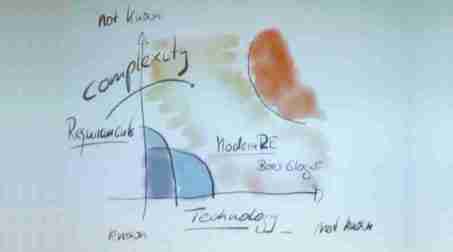
At SE-Trends there is already a lot to Complexity to read. Langdon Morris points out that complexity causes non-intuitive behavior.
Complexity generates counter-intuitive behavior
Langdon Morris
Here too, he cites a number of examples, such as the ageing of society, which is already in full swing in Japan, for example, but is only just beginning in China.
The end of exponential growth in many areas of society, and the economy in particular, means that we will soon have to rethink our approach.

Langdon describes the need to rethink as a turning point. In doing so, he picks up on a theme that was already Prof. Olivier de Weck in his CSD&M keynote speech mentioned above: As complexity increases, the incremental return decreases until it possibly becomes negative.
Innovation
The possible solution is innovation. Using the example of Apollo 13, Langdon shares an anecdote of how digital technology was used in defiance of management, which ultimately enabled the rescue of the Apollo 13 astronauts.
But this is the crux of the matter where we systems engineers come in: Systems engineering is not possible without innovation. We have to be innovative in order to realize added value for the users. But management abhors innovation: innovation is risky, slow, expensive... uncontrollable and difficult to manage.
The ironic thing is that the management does what it is paid to do. After all, shareholders want predictable (positive) results. One of management's tasks is therefore to avoid variation. And innovation generates a lot of variation!
However, as innovation is more important than ever for successful competition, successful companies must create a balance here, and this is already happening. There are many techniques for this, although the whole thing will not work without management buy-in.
But if the company management creates the appropriate framework conditions, then we Systems Engineers have the freedom - and the obligation - to find innovative solutions for future challenges.
Incose Keynote: The Big Shift: Innovation and Systems Engineering
Image sources with permission from Langdon Morris: Title: YouTubeDiagrams: YouTube