Interview with Prof. Bernhard Rumpe: Industrialization with modelling
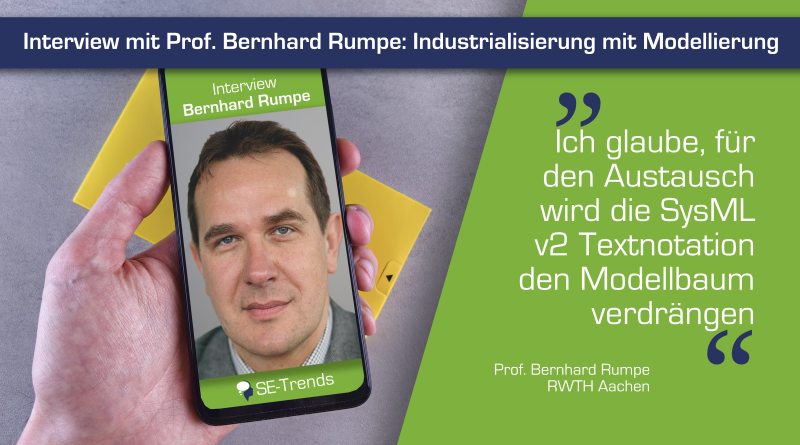
On July 1, 2025, I had a conversation with Bernhard Rumpe, professor at RWTH Aachen University and expert in systems engineering. The conversation focused on a question that could not be more topical: How do we get out of the acute industrial crisis? How can we manage to steer complexity into manageable channels and thus develop systems faster and more reliably? How can modeling and MBSE help us do this?
Below is not only a summary, but also the complete conversation as a video.
Prof. Bernhard Rumpe
Bernhard Rumpe is Professor of Software Engineering at RWTH Aachen University. Even during his computer science studies, Rumpe was fascinated by the idea of taking a more systematic approach to software development. He was working on his doctorate when UML emerged. He was not only interested in software engineering, but in the formal modeling of complex systems as a whole. The strong presence of mechanical engineering in Aachen certainly helped, as we will see later in our conversation.
We not only have a strong computer science department in Aachen, but also a very strong mechanical engineering department. We can cooperate very well with our colleagues from mechanical engineering.
Prof. Bernhard Rumpe
MontiCore: Technical superstructure
MontiCore is a language workbench that Rumpe has been developing since 2006. It is a tool for developing tools with a focus on text-based modeling. The platform is used in many research projects, including for domain-specific languages in areas such as AUTOSAR, but also insurance, to name just two examples.
We have a library of over 80 language components that you can glue together to build your own DSL with MontiCore.
Prof. Bernhard Rumpe
The language components can be used to quickly build your own DSLs. However, existing languages such as Java or SysML have also been implemented with MontiCore as a proof of concept.
Modeling: SysML solves different problems than UML
UML may not have kept all its promises, but it has nevertheless achieved a great deal. It has become a kind of lingua franca. For example, every developer can now read a class diagram.
Agile methods were perceived as a counter-movement at the time, but Rumpe doesn't see it that way: After all, modeling can even support agile working.
SysML is only comparable with UML to a limited extent, as hardware is inherently different from software: after all, you can't just rebuild a car. This is why it is so important to model virtually in hardware. This is something that SysML makes possible. Although there are often better, specialized modeling tools in design (simulation, CAD, etc.), we can only get the overall view, i.e. architecture and engineering together, with SysML. SysML is the best option we have for this.
SysML v2
SysML v2 brings many advantages for exchange thanks to the textual notation. Of course, the model is not text. Nevertheless, text is ideal for coupling and libraries, as we have seen in software development.
I believe that the SysML v2 text notation will replace the model tree for the exchange. The model tree is important in the project, but if I want to achieve reuse at model level, the library construct is much more important. And this can be realized much better with text notation.
Prof. Bernhard Rumpe
Decoupling, as achieved in the software with classes, has brought enormous productivity boosts. SysML v2 does not force this decoupling, but it offers it. However, you really have to do it methodically.
The RWTH is working on this topic. Unfortunately, however, far too few are working on building a SysML component ecosystem.
Break between architectural and design models
Rumpe confirmed a topic that has been on my mind for a while: To this day, there is a disconnect between architecture and design models. Technologies like OSLC or integrated solutions such as Flow Engineering are trying to change this, but are not yet really widespread. Rumpe was able to name a few companies that work in an integrated way, such as JPL (NASA), Tesla or Tata. I will do some research into this.
The first time is not faster or cheaper, as the effort remains. But you can distribute the work better across different groups, for example with virtual quality assurance and faster feedback.
In the medium term, a model-based infrastructure makes it possible to develop the next product variant much faster. The initial outlay is worthwhile in the medium term if you know that products of a similar type will be built again and again.
Prof. Bernhard Rumpe
Although there is awareness of this problem in Germany, existing structures are slowing down progress. These are not only of a cultural nature: a lot of knowledge is contained in the tools that have been used for decades. You can't just throw that away, and migration simply takes time.
Incidentally, models for modular reuse are also created in mechanical engineering, both in SysML and in other forms. It is interesting to note that there are also functional constructs that model energy or matter as input and output.
Mechanical engineering has developed more than 300 elementary functions that describe all physical effects.
Prof. Bernhard Rumpe
Tools need a toolsmith
SysML and UML are not trivial languages. They require sophisticated, user-friendly tools. Manufacturers have a dilemma: as soon as the tools become too specialized, customers abandon them. This applies not only to specialization in terms of the domain, but also the methodology.
One possible solution would be a plug-in marketplace through which providers could sell specializations, but this has not caught on, at least for modelling tools.
In practice, mature teams and organizations have a so-called toolsmith, i.e. a person who is responsible for tool adaptations and integrations.
The Toolsmith adapts the tool so that it does what it is supposed to do. The toolsmith can be integrated directly into the project. Larger companies sometimes have a toolsmith department that takes care of all kinds of projects.
Prof. Bernhard Rumpe
Finally, Rumpe laments that customers are often not even aware of how much power they have over tool manufacturers. They could demand a lot here, but they don't. He also believes that legislators have a duty, especially in the current situation in Germany.
The future
A single measure will not be enough, says Rumpe. Companies need courage. SysML is certainly part of the solution, but it has to be used for big things. The core issues are migration, which many companies struggle with, and modular components, as well as functioning tools, which do not work today without adaptation. It won't work without help from the legislator.
Automotive will not succeed without the help of politics. Digital engineering needs the right tools. Getting there is not a sprint, but a marathon.
Prof. Bernhard Rumpe
Conclusion: Time to market must become significantly shorter. In development, this can only be achieved by using models. And in the end, the model itself also becomes part of the product: customers want to buy the model because it is a powerful enabler, for example for the digital twin.
Finally, Rumpe mentioned that new tools and methods are also being worked on in other markets, such as Asia. There is a lot to do if we don't want to be left behind.