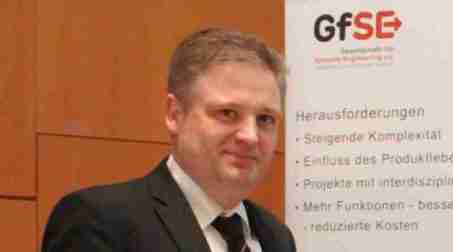
Interview with Martin Häuer: Open source hardware and systems engineering

Open source has already turned the software market upside down. Achieving the same for hardware is one of the goals of the Open Source Ecology Germany e.V. (non-profit organization). In this article, Paul Jerchel conducted an interview with Martin Häuer, Chairman of the Board of the association. In addition to this role, Martin is chairman of the DIN Young Professionals, Contributor in the CEN/CENELEC "Open Source Solutions" project and co-initiator and director of the DIN SPEC 3105 "Open source hardware"a pilot for open standardization.
Guest interview by Paul Jerchel with Martin Häuer
With over 4000 participants, the Networks 2021 probably by far the biggest online conference I have had the pleasure of attending. Already in the run-up to the NetOpen21: Modeling Open Innovation Communities with Network Science a small but excellent sub-conference was held on the topic of the dynamics of knowledge transfer of freely usable technical documentation. Also for the Systems Engineering it could be an interesting question as to which processes can promote the success of development processes with large constellations of actors.
In the area of open source hardware and software, only the basic requirements are often defined jointly. Due to the possibility of specification and free use, many of the more specific requirements remain with the users themselves. Building communities around certain projects or topics can contribute to their long-term, strategic orientation.
I talked to Martin Häuer, research associate at the Fraunhofer Institute for Production Systems and Design Technology IPK in the Department of Virtual Product Creation and Chairman of the Board of Open Source Ecology Germany e.V. (non-profit organization) entertain.
First of all, what is open source hardware?
This is hardware for which the general public has been granted free exploitation rights and whose technical documentation is freely available. In practice, this means that you do not have to develop hardware from scratch, but can also use modules that have already been developed externally and then recombine and expand them for your own application.
This potentially results in significant cost and time savings in the development phase. The broad, low-threshold application of open source technologies also enables decentralized long-term testing under various environmental conditions. This has been clearly evident in the software sector for over 40 years: FOSS is generally more stable and secure than proprietary software - in addition to other advantages such as high compatibility and long-term support.
Open source solutions are no longer dependent on the original developer once they have been published. For example, I could still maintain and expand an open source welding robot in 20 years' time and even procure spare parts according to the construction plans independently of the manufacturer.
Have I missed a trend? How can this pay off for companies?
Open source hardware is already "a thing" in large-scale and basic research. CERN is one of the major drivers in this area and, with the Open Hardware Repository a separate instance for electronic open hardware. One of the most prominent projects there is White Rabbita system for highly synchronous data transmission in a geographically distributed computer network. As the researchers are already open-sourcing the project during development, the solution is now being used in areas such as the financial sector, telecommunications, the energy industry, the IoT areaair traffic control and elsewhere applied. In addition, open source hardware is also widespread in industries that are "more than busy enough" with pure R&D and have high IT security requirements, Complexity reduction and environmental protection.
Open source hardware is indeed already "a thing" in large-scale and basic research.
Martin Häuer
Open source solutions can also be used as a method of setting technical rules - open source de facto standards, so to speak. With open source solutions, historically grown incompatibilities can be elegantly eliminated, as the development of parallel solutions for identical or very similar problems makes little sense. Ultimately, the better solution with low-threshold applicability will prevail. If there is then a problem or an improvement suggestion for the core technology in the practical application, these improvements are incorporated there and automatically benefit all users "below" them.
The Physikalisch-Technische-Bundesanstalt is currently developing a Open source MRI. You can imagine the revolutionary Effect for this sector. Smaller companies benefit from low barriers to entry into new sectors and can offer products-as-a-service or tailor-made services through specialization. Startups can quickly gain attention and artificially increase their workforce through tech communities. Ideally, corporate customers can be offered endless support.
Where do systems engineering and open source hardware overlap?
During our consultations, we repeatedly meet engineers from the mechanical engineering sector and other spheres who are interested in development in non-linear platforms such as git-based systems is simply not familiar. I didn't have that in my studies either - but I should have! Systems engineers, on the other hand, certainly have a whole range of skills that are already closely linked to the skills profile required for open source hardware.
Non-linear platforms such as git are hardly known outside of software development
Martin Häuer
Collaboration and Communication is an integral part of engineering in both sectors. Professionals in both fields are usually aware of the relevance of combining individual development services and combining them in different areas. "Languages" to think. The Network thinking and the (positive) inclusion of Emergence is an integral part of every consideration for open source hardware. In addition Modularity a core concept in both disciplines - system engineers with experience in product data and contribution management are therefore often already familiar with our questions and can answer central questions. Responsible parties for pilot projects.
How can systems engineers use their skills for "open source ecologies"?
First and foremost, the principle "We are standing on the shoulders of giants" applies. It is therefore important to develop the work of temporary alliances and corporate cooperations on a permanent basis. A corresponding potential analysis should therefore be carried out with a thorough technology research, strategic evaluation, integration into existing processes and contacting the relevant communities.
In the current project Traceability, Change management and validation are central topics - so for systems engineers it is only a small step, but one that can be a huge advertisement for the company. Imagine if you had invented the Linux kernel!
So where can I get more information?
I currently recommend the new EU Report on the economic importance of open source solutions. In addition, the Open Source Business Alliance is a good first port of call for both large and small companies with a software focus. And if you want specific advice on open source hardware and standardization, you can also contact by mail contact us directly.

Paul Jerchel conducted this interview
Paul Jerchel studied mechatronics at the Berlin University of Applied Sciences (BHT) and worked in microelectronic reliability testing, process and strategy development at various scientific organizations and institutes. Michael Jastram's contribution to the Circular economy inspired him to write this article.
Picture sources: Timm Wille (portrait of Paul Jerchel) and Martin Häuer (CC-BY-ND-4.0)