How BMW and Daimler deal with increasing complexity
I recently came across an interesting interview in which Michael Schmidt (BMW) and Frank Homberger (Daimler) shared their perspective on software-generated complexity in vehicles.
The interview was conducted by Philipp Noll from Spread (Video subject to registration). Frank Homberger is Manager for Digital Verification Processes at Daimler AG (or Mercedes-Benz Group AG), Michael Schmidt is General Manager Digitization at BMW.
Complexity as a major challenge
Complexity in automotive is a challenge, without question. But Frank Homberger doubts whether established manufacturers have more problems with complexity than new market entrants and refers to the initial problems of Tesla in Berlin-Brandenburg. However, he does concede that, unlike new competitors, established OEMs have to take existing product ranges into account, which increases complexity.
Michael Schmidt also agreed with this and believes that German manufacturers are not in a bad position when it comes to mastering complexity. He pointed out that many competitors are not under the same pressure to earn money. He left open why this was the case. I assume that he was referring in particular to subsidies from the Chinese government, whereby these according to the Economist, at least for the time being, not yet having too great an impact on the market.
Using data, breaking down silos, establishing a digital twin
The flood of data in vehicles is increasing, driven by more software and sensor technology. At present, this data is not yet being used effectively. Michael Schmidt confirmed this. He sees isolated data islands at BMW. The vision is to merge these islands into a platform that users can access without special knowledge. Today, there is a disconnect between development, production and operations. Data formats and the possibility of linking them are not even the main problem. What is missing is a semantic consistency of processes.
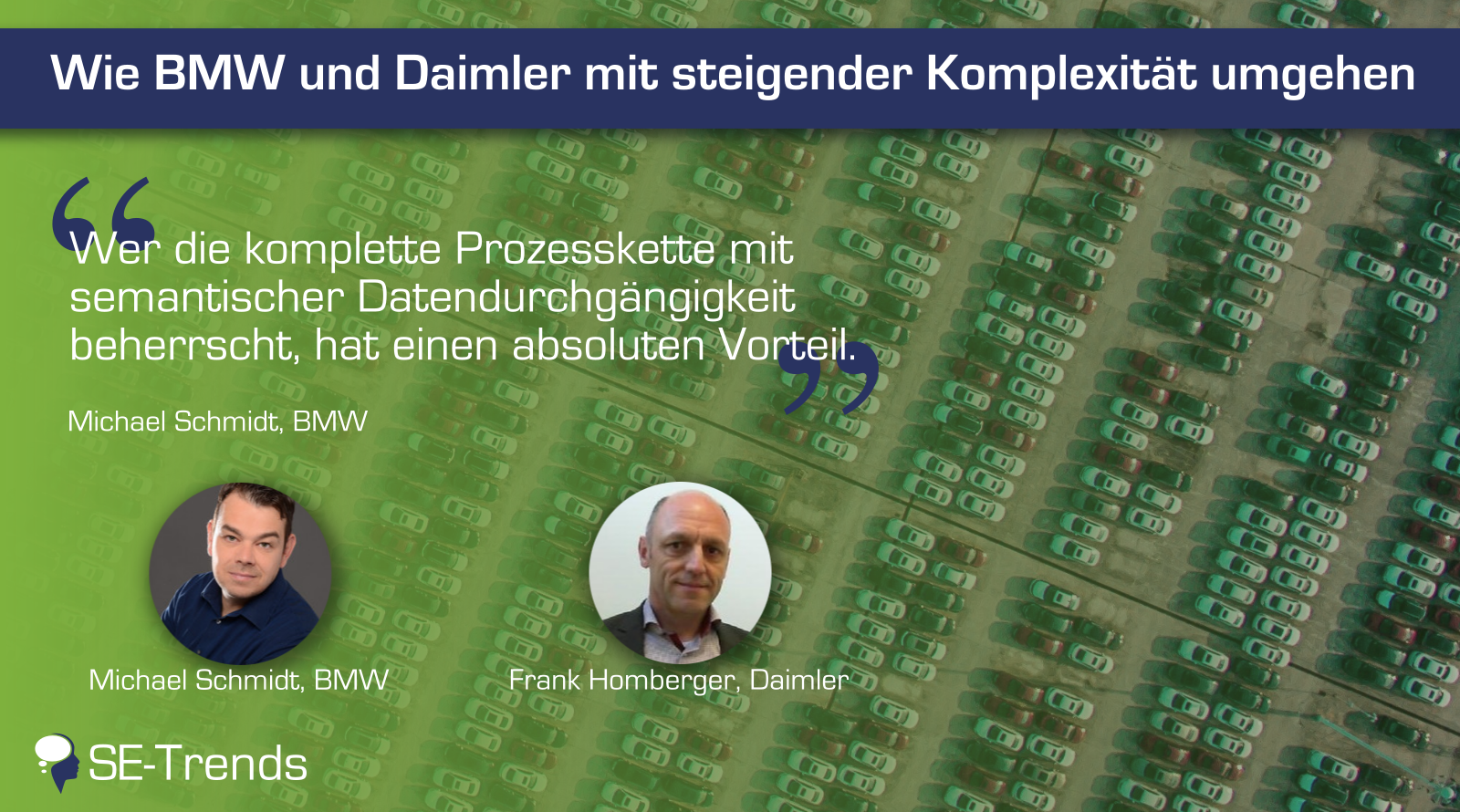
Those who truly master the entire process chain, with semantic data consistency and high data quality, have an absolute advantage.
Michael Schmidt, BMW
Frank Homberger from Daimler confirmed this and then used the buzzword Digital twin as an important solution concept.
Taking people with you, alleviating the shortage of skilled workers
Frank Homberger also emphasized how important it is to take people along and involve them. He has experienced the fears of employees, some of whom are also opposed to a new digital product.
And that's not all: Michael Schmidt pointed out that the old hands in particular do not recognize the value of new solutions, as they can fall back on their many years of experience. But not everyone is an old hand and, in times of a shortage of skilled workers, there is enormous potential here to make less experienced employees effective and productive quickly.
Software Driven Factory, reduction of variance and other solution approaches
Daimler has created its own strategic initiative for this topic under the name "Software Driven Factory". The newly developed Operating system MB.OSthat has been developed since 2021 and is due to be launched this year.
BMW appears to be taking a more iterative approach to the necessary transformation process. Michael Schmidt emphasized that BMW is already doing a lot of things right and well, but that things still need to become more efficient and simpler. He considered the reduction of variance to be an important issue, especially when it came to controlling costs.
Variant management is also a major topic at Daimler. They are experimenting with it, Variants to be unlocked via software (as is already the case with other manufacturers). It is not yet clear whether the business case pays off, as the hardware is not absolutely necessary. It only pays off if customers really do unlock additional features at a later date for a fee.
Conclusion
This interview clearly shows that German OEMs are under enormous pressure. The interviewees mentioned the competition from China several times. While Daimler is trying to reinvent itself with a new strategy, BMW is following a path of incremental improvement. Time will tell whether and how well the companies will master these challenges.