


INCOSE Vision 2035
The INCOSE Systems Engineering Vision 2035 describes trends in systems engineering and how we can utilize these developments.
Product Velocity is a new approach that enables companies to learn faster, make decisions more quickly, and deliver results.
Agility Requirements Attack security Architecture Automotive Barcamp Digital transformation Eclipse GfSE Hardware Innovation Integration Communication Complexity Conferences Artificial intelligence MBSE Modeling Traceability Openness PLM Product development Processes Quality ReConf Interface Semiant Security Software SpaceX Standards SysML SysML v2 Systems thinking Systems Engineering TdSE Tim Weilkiens Traceability Transformation Trends UML Video Christmas Further training Tools

The INCOSE Systems Engineering Vision 2035 describes trends in systems engineering and how we can utilize these developments.

Increasing complexity places high demands on quality management. This is particularly the case when quality is concerned with (functional) safety. Embedded systems belong to the class of products where this is a major challenge. One of the reasons for this is that software is one of the main drivers of complexity. A typical example would be...

System models often have limited ability to represent physics. Physical models are helpful, but they must not lead to silos.
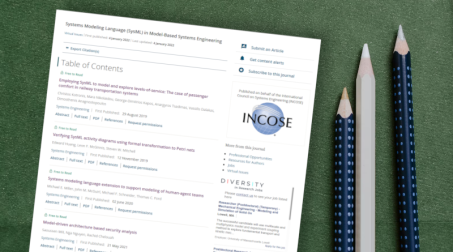
INCOSE has published a special on SysML, which can be read free of charge at Wiley until April 15, 2022. After that, it is subject to a charge or requires a membership.

Model-based working is one way of dealing with increasing complexity. However, it is not easy to work successfully in a team based on models. In this respect, it is often helpful to get impulses from practice. In today's guest article, Carsten Pitz reports on how specification models help to bridge the gap between requirements and the world of modeling.

A SysML model is much more than a diagram. This example with Cameo shows model simulation, with video.

The Agile Manifesto is twenty years old. It feels like agility has been around for an eternity, which is certainly also due to the fact that teams have been practicing agility for much longer. Twenty years ago, the child was simply given a name and systematized, which has dramatically raised the profile of agility. Of course, not all teams practice agility. And not everything...

A lot is currently happening again with SysML, as the initial submission of the standard took place in August. A revised version is expected to be submitted in the middle of next year. This week, a virtual meeting of the SysML v2 Submission Team (SST) took place, at which the current status was described and which I attended. Also...
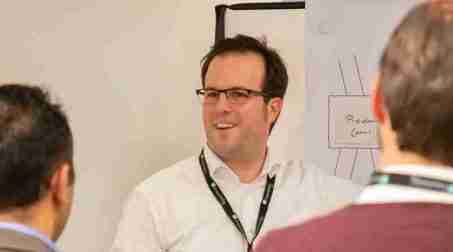
Christian Tschirner is Deputy Chairman of the Society for Systems Engineering (GfSE). Two years ago, he founded the company Two Pillars, which distributes the Japanese tool iQuavis and develops it further for mechanical and plant engineering. iQUAVIS is a lean platform for model-based product development. iQuavis does not rely on SysML, but on a lightweight data model. On April 27...

Yesterday, on June 17, 2020, I gave a talk entitled "Pragmatic Systems Engineering through Modeling" as part of the GfSE webinar series. I captured the pragmatism in the form of 7 tips, which are summarized here for those who missed the webinar.

You can already read a lot about SysML - the Systems Modeling Language - on this blog. But today I would like to discuss an important concept that is often used to characterize SysML.

ReConf is one of the best-known conferences in Germany on the subject of requirements management, which is an important part of systems engineering. Once again this year, I will be attending ReConf not only as a participant but also as a lecturer with several contributions.
Unfortunately this website uses cookies! The website also works without cookies, but then you won't be able to watch videos or leave comments. You can decide for yourself what you allow. Data protection comes first - we promise!