


Anti-Patterns in Systems Engineering: When Everything Is Green
Marc Löffler and Michael Jastram discuss anti-patterns in systems engineering and the watermelon pattern. Here is a summary.
Product Velocity is a new approach that enables companies to learn faster, make decisions more quickly, and deliver results.
Agility Requirements Attack security Architecture Automotive Barcamp Digital transformation Eclipse GfSE Hardware Innovation Integration Communication Complexity Conferences Artificial intelligence MBSE Modeling Traceability Openness PLM Product development Processes Quality ReConf Interface Semiant Security Software SpaceX Standards SysML SysML v2 Systems thinking Systems Engineering TdSE Tim Weilkiens Traceability Transformation Trends UML Video Christmas Further training Tools
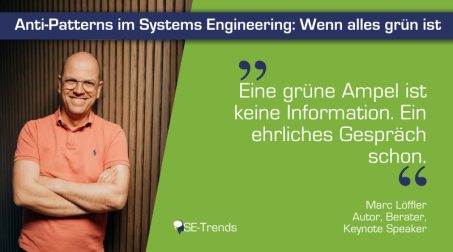
Marc Löffler and Michael Jastram discuss anti-patterns in systems engineering and the watermelon pattern. Here is a summary.

If you ignore the physics when calling a function during development, you won't discover errors until integration.

Drawing on Robin Yeman’s keynote address at the MBSE Summit, this article explains capability threads and how integration bottlenecks arise despite MBSE.

The workshop of the GfSE Agile Systems Engineering working group focused on SEBRAS, Stripes and spreading good ideas.

In this keynote speech, Martin Eigner shows how software, systems and services are changing product development.

There is now also an Expansion Pack for the Scrum Guide, which is relevant for Systems Engineering and Product Velocity.

In this interview, Sebastian Völkl explains why he founded Dalus and how MBSE and SysML v2 bring real benefits.

Flow engineering enables seamless model integration with the requirements. This enables short iterations.

Medical technology started introducing systems engineering quite late. This enables a pragmatic approach.

One area of application for AI in product development that is often overlooked at present is change management

Of course, there are more things that systems engineers need to do than those described below. But this is about simple things that deliver tangible results with little effort ("low-hanging fruit"). The things listed here are also of a tactical nature: they can be introduced, or drastic changes can be made to processes, methods or tools...

Next week the Modern RE will take place in Berlin. I'm looking forward to seeing many old and new faces there: At my presentation of a case study on agile requirements management, or just for fun. But what distinguishes modern requirements engineering from traditional requirements engineering? There are three pillars that I will be presenting today.
Unfortunately this website uses cookies! The website also works without cookies, but then you won't be able to watch videos or leave comments. You can decide for yourself what you allow. Data protection comes first - we promise!