


Can systems engineering save the automotive industry? No, but...
Not a day goes by without either another piece of bad news about the automotive industry or an expert giving their opinion on how the automotive industry can be saved. Well then, I'll join in.
First of all: there is of course no lack of the one idea that everyone has been waiting for. Transformation is a lengthy process. The question is rather: since we are now in a crisis, what strategy (not tactics!) will lead us out of the crisis in the long term, what courageous steps must decision-makers take today so that the German automotive industry will still be relevant in five (or ten) years' time.
My answer is sure to surprise readers.
China
Anyone who takes China seriously could have predicted the crisis. China first publicly formulated its ambitions to become a global leader in the automotive industry as part of the "Made in China 2025" strategy. This initiative was introduced by the Chinese government in 2015 and focuses on modernization and technological independence in various key industries, including the automotive sector. The aim of the strategy is to increase the competitiveness of Chinese companies, reduce dependence on foreign technology and achieve global leadership positions, particularly in the field of electromobility and new drive technologies.
As part of this initiative, China has not only invested considerable resources in research and development, but has also strongly promoted electromobility in order to play a dominant role in the automotive industry in the future. The promotion of start-ups and support for large Chinese car manufacturers such as BYD and NIO are also part of this strategy.
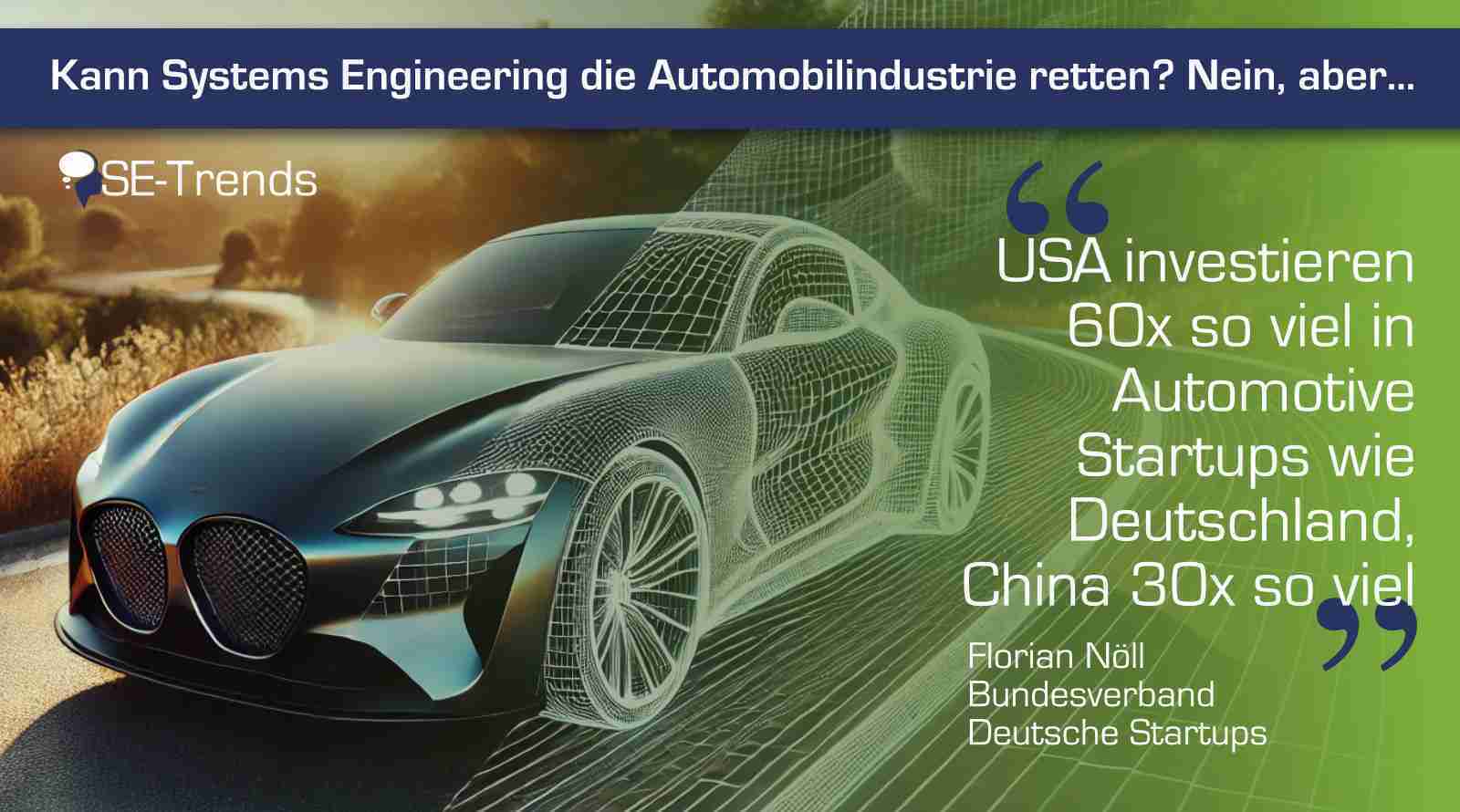
I don't want to say: "I told you so!". But I already pointed out the danger in this blog in 2017 and in 2018, a German investor pointed out that Automotive startup investments in China are approx. 30 times and in the USA approx. 60 times higher than in Germany.
The Business Week focuses on the issues for industry, the country, politics and, as the name suggests, the economy. The crisis affects all German OEMs, whether mass market (VW), premium (Mercedes) or supplier (ContinentalZF and many more). It's not just about sales, but also about quality (as was recently the case with BMW). Politicians are speaking out and factory capacity utilization is becoming a problem. The trade unions are already gearing up.
Digitalization and "software-defined vehicle"
The ironic thing is that it was also clear over ten years ago that software for vehicles would play a huge role. As a reminder, the first autonomous vehicles appeared on the roads in 2014, but they had been in development for much longer. At the time, many experts were already wondering whether tech companies would take on a pioneering role and overtake traditional vehicle manufacturers.
Chinese companies, such as BYD, took Tesla as a model and developed new vehicle architectures. Tesla had already recognized at the time that modern cars would need a new, software-centric architecture. Unfortunately, the local industry also missed out on this development. As a reminder: Cariad was only founded in 2019.
Gartner has now published the 2024 Digital Automaker Index and the result is depressing (here the Summary by Philipp Raasch). The current situation is sobering: only three established vehicle manufacturers can be found in the top ten: Ford, GM and BMW occupy 8th, 9th and 10th place respectively, while Mercedes (11th) and VW (13th) are still in the top 15.
Instead of optimization, the focus today is on reinventing the entire business model. Let's see when we see the first tech CEO at a traditional car manufacturer.
Philipp Raasch
Gartner sees 5 reasons for the result:
- Lack of commitment from decision-makers to the software focus
- Cultural change from traditional manufacturer to software company
- Shortage of skilled workers, in particular
- Unattractive employer for software engineers
- Inefficient use of resources
- Missing E/E architecture
Systems engineering in the automotive environment
I would argue that Germany and Europe (especially France) have a very high level of maturity in automotive systems engineering. For example Mercedes already made a strong commitment to MBSE in 2016 has been announced. However, this has not averted the current crisis.
This does not mean that systems engineering does not represent a competitive advantage, quite the opposite: without systems engineering, it will hardly be possible to build high-quality, safe vehicles. We will see how good the young competitors really are when they are increasingly to be found on Western roads.
Furthermore, I have often argued that in particular MBSE an enabler for agile development and, if used correctly, promotes innovation.
Unfortunately, however, MBSE in particular can also lead to silo formation. It is a technology that is initially neutral. To be effective, it must be used correctly.
My advice: We need more start-ups!
We have an enormous amount of talent in Germany. But we have a major problem mobilizing this talent. On top of that, jobs are being cut in the automotive sector for cost reasons. Many talented people are on the job market and are interested in continuing to work in their field and contributing to the success of something big. But as I said at the beginning: we are not investing nearly enough in automotive start-ups.
Investors often turn away when they hear "automotive"
America in particular has an enormously active start-up scene that we can only dream of. Tesla is a good example of how a start-up can roll up the market. GM has shown how to build a startup like Cruise and integrate it without destroying it.
Recently, we have been hearing again and again from politicians how important it is to promote start-ups. I hope that these words will be followed by more action than has been the case in the past.


