


Automotive needs systems engineering more than ever

One piece of bad news follows the next: Mercedes uses BMW engines; Chinese AUDIs are merely rebranded by Chinese manufacturer IM Motors; Xiaomi poaches BMW executives. Will the German and European automotive industry recover?
Admittedly, SE trends are not usually about politics or missed opportunities, but about technology and systems engineering. Nevertheless, it is important to understand the way things work in order to be able to tackle the underlying problems.
So to round off the summer, let's take another look at the automotive industry, how it came about and how looking through the lens of systems engineering can help us to get to grips with the problems at both the technical and decision-maker level.
Shock in the 2010s: Tesla e-cars and autonomous driving
Tesla made the electric car competitive in 2012 with the Model S. Just one year later, Google announced that its vehicles had already driven over half a million kilometers autonomously. Both events caused surprisingly little reaction in Europe. Neither was taken seriously enough for a long time.
The Google car has now [2013] driven more than half a million miles without causing an accident-about twice as far as the average American driver goes before crashing.
The New Yorker, 2013
Mercedes' reaction was an indication of the 2013 autonomously driven historical route of 100 km between Mannheim and Pforzheimwhich is a remarkable achievement. Mercedes now also has a level 3 vehicle on the market, but so do Honda and BMW. In addition, RoboTaxis from Waymo, Tesla and Baidu already have level 4.
Unfortunately, Germany missed this wake-up call, which I already pointed out in 2017/18. The fat years before coronavirus passed by unused.
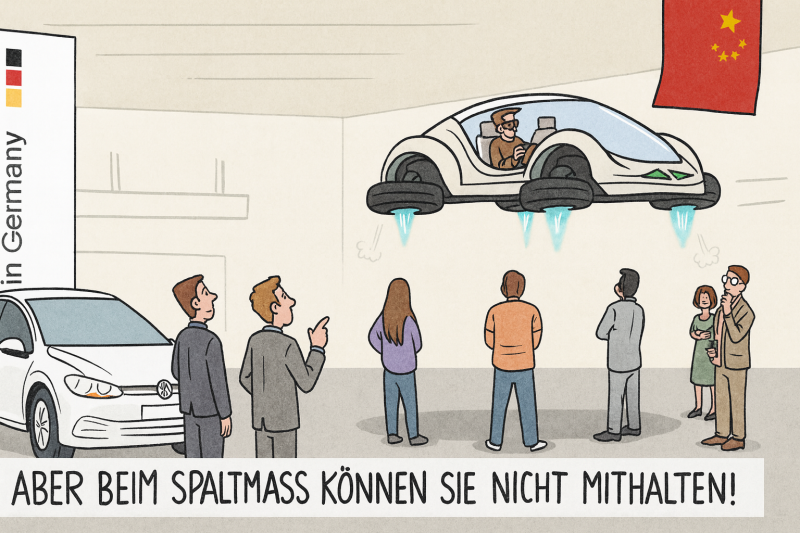
Software-Driven Vehicle & China Speed
But shortly before Corona, something finally happens: word gets around that software is more important than gap dimensions. Shortly before Corona, the Cariad is being built. The Eclipse project is evolving into a software-driven vehicle, as the industry slowly understands the importance of software for modern product development.
But unfortunately, Cariad is failing because of politics (both internal and external), with politicians half-heartedly wavering back and forth between the combustion engine and the electric car.
Others cannot be stopped
- The USA has always had an affinity for start-ups and invests approx. 60 times more in automotive start-ups than Germany. Inspired by Tesla, many new automotive start-ups were formed there, such as Cruise.
- China recognized the signs of the times even earlier and declared electric cars and battery technologies to be a strategic development goal of its industrial policy in 2009.
The result is sobering: in 2025, the German automotive industry will face enormous challenges that will be felt throughout Germany:
- According to EY almost 50,000 jobs were lost from the automotive industry in Germany last year.
- The Chinese market for German OEMs is collapsing: In the first quarter of 2025, Porsche no 3000 cars sold there and possibly withdraws.
- Successful managers of German automotive companies switch to Chinese manufacturers.
Looking ahead: Product Velocity with Systems Engineering
Statements from BYD, Xiaomi and other competitors that they can take cars from concept to production in 18 months are another bombshell. A few years ago, VW was still at 48 months, but is starting to catch up.
The speed of development is one of the most important skills for remaining competitive today. Unfortunately, decision-makers at German OEMs have not really understood how this can be achieved: They thought software was the solution. But that's not true: software is only part of the solution. Moreover, hardware is not disappearing. Software development for highly integrated systems such as cars is fundamentally different from the development of user software or embedded systems.
Software is only part of the solution, not the solution. Vehicles need a platform similar to the smartphone, with a clean architecture and clear abstraction between hardware and software through properly managed APIs.
Michael Jastram
It is not really surprising that a smartphone manufacturer like Xiaomi has suddenly managed to successfully build cars. The figures are indeed impressive:
- The Xiaomi SU7 received a lot of attention within the first Almost 90,000 orders 24 hours after launch
- The Xiaomi YU7 received 200,000 pre-orders within 3 minutes and Xiaomi started to call customers because of the long waiting times. refer to competitors.
Xiaomi and others understand that a modern car must be built like a smartphone: A smartphone app cannot jeopardize the overall system*, but can still make full use of its hardware.
* Of course there are security gaps, but mobile operating systems are much more secure by design than traditional operating systems without a rights framework thanks to sensible rights management.
Frameworks and architecture: more than just software
Consequently, the trend in the automotive sector is moving away from pure software thinking (SDV) towards platform thinking. BYD is an impressive example of how a good platform (BYD e-platform 3) a vehicle development can be compressed into 18 months - without compromising on safety*.
* Again, a footnote, because there are still security problems, such as recently with the Xiaomi SU7. But at least at the moment, the (known) accident rate does not appear to differ significantly from western vehicles.
VW has now also realized this and is making progress. The Target period for new projects is less than 30 months, VW creates demonstrably already 40 months. Which is still twice as long as BYD.
The solution: knowledge transfer from China
We will not be able to catch up in the short term; Germany is now years behind in vehicle development. The most sensible solution for all sides is knowledge transfer. After decades of exporting our knowledge to China, it's time to benefit from the Chinese lead. There's nothing wrong with that, even if some people think it's a good idea. like betrayal may seem.
But to think this way fails to recognize that the automotive industry has long been globally intertwined. German engineers at BYD or Xiaomi reflect this. Those who speak of betrayal forget that German manufacturers themselves have earned billions in China over decades and exported their knowledge. Now knowledge is flowing in the other direction. It feels strange, but it is continuity. Globalization can create value for both sides - and German jobs.
There are also technical opportunities here: Chinese manufacturers consistently rely on modern software platforms, zonal architectures and fast decision-making cycles. German specialists working there are gaining experience with highly integrated battery systems, over-the-air updates and service-oriented E/E architectures. This knowledge can be brought back to Germany. This potential has more value than compartmentalization.
Conclusion
The German automotive industry has spent many years feeding off the past and ignoring warning signals. Now everyone is suddenly passing us by. Today, systems, platforms and architectures determine speed and competitiveness. It is not enough to build software; only end-to-end systems engineering enables the integration of hardware, software and services on a global scale. In other words: Product Velocity.
Germany has already lost the lead in Automotive. But instead of putting up walls, we should learn from the successes of others. Knowledge transfer, global cooperation and a clear focus on clean architectures and platforms can put us back in a position to play a leading role. But only if we don't close our eyes to reality, but instead build better systems for the long term.


