Agile Product Operating Model: The path to agile product development
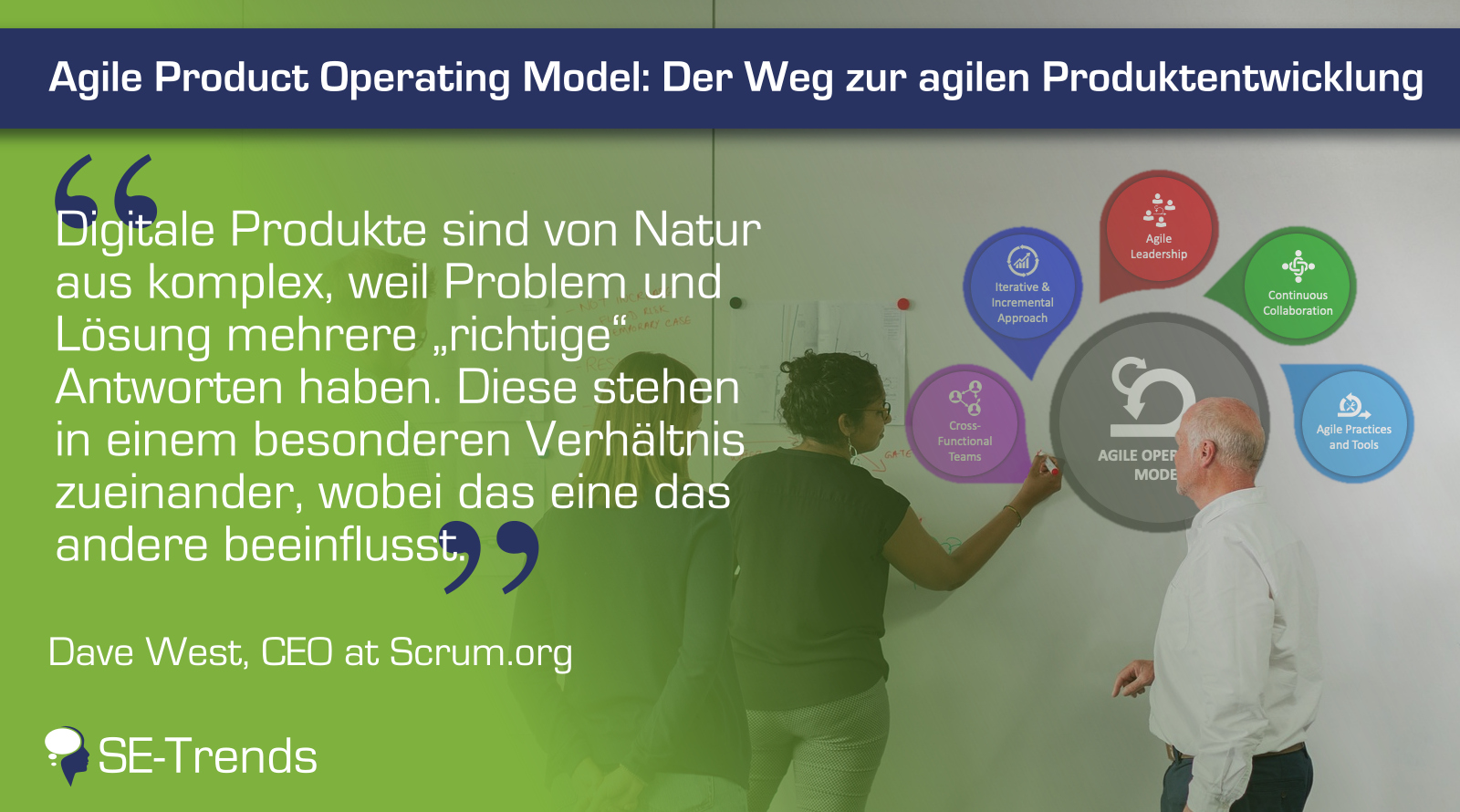
Today's topic is currently on the minds of many specialists and managers: Is agile product development the path to sustainable business success? If so, how do I get there? One possible answer is the "Agile Product Operating Model", an agile framework for product development.
The term was coined by Marty Cagan, among others, in his book "Transformed". Dave West, CEO of Scrum.org, has also taken up the topic. My conclusion: we are moving in the right direction here, but there is also a big elephant that nobody is talking about (hint: it has something to do with silos).
By the way: At SE-Trends you will now find 450 specialist articles that are accessed half a million times a year. Help me to spread the word about SE-Trends by participating in the SE-Trends Survey.
Agile Product Operating Model
The Agile Product Operating Model is a framework that aims to integrate agile principles and practices into a company's product development and operational processes. In other words, the success of agile development, which was initially limited to software development, should also be realized for operations, including the development of non-software products.
Features of the Agile Product Operating Model are:
- Customer orientationFocusing on the needs and requirements of customers to develop products that offer high added value.
- Iterative developmentProducts are developed in short, repeatable cycles (sprints), which enables rapid adaptation to changes.
- Interdisciplinary teamsTeams are made up of members with different skills and expertise who work closely together to achieve common goals.
- Transparency and communicationOpen communication and transparent processes to ensure that everyone involved is on the same page and can work together effectively.
- Flexibility and adaptabilityAbility to react quickly to changes in the market or in customer requirements and to adapt product development accordingly.
Sounds good, but...
That sounds good at first, but not really revolutionary either. What is missing here are the reasons why we have not been developing in this way for a long time. Specifically:
- Traditional workflows allow long iterations at best. From one 2-day cycle, as with the SpaceX Rapor enginesmost teams are a long way off
- Existing culture makes restructuring into interdisciplinary teams almost impossible.
- Poor tools are often an important obstacle to transparency and communication (although culture also plays an important role here). I have experienced many teams where the good will was there, but IT made the necessary transparency impossible or caused considerable friction losses.
- Mechanics, electronics and software must be treated differently. Unfortunately, these three domains are often lumped together. Or, as is currently the case in the automotive environment, domains are ignored. If you believe the OEMs, then the software-defined vehicle mechanics and electronics are almost irrelevant.
Help with implementation
The book Transformed by Marty Cagan is dedicated to precisely this topic in three steps:
- First, the book provides a deep understanding of the Product Operating Model and what it means to work this way.
- With the help of case studies of successful transformations, the author shows that although it is difficult, it is certainly possible to convert a company to the Product Operating Model.
- Finally, the book provides concrete assistance for implementation in order to sustainably transform existing organizations.
These Review by Stefan Wolpers goes into a little more detail.
Marty Cagan lets the word Agility even if the approach is clearly agile. Dave West, CEO of Scrum.org, speaks explicitly of the Agile Product Operating Model in this interview.
Silos: The elephant in the room that nobody talks about
One thing is clear: agile product development is not possible without the right culture, mindset and people. However, the topic of tools and data transparency is often only addressed in passing. We must not forget this: The success of agile software development is partly due to the availability of affordable tools that enable transparency across the entire development chain, from requirements to architecture, code, tests, deployment, etc.
In (hardware) product development, we currently have many gaps that can hardly be bridged: between requirements, (CAD) design, system model, tests, electronics and much more. Companies like Flow Engineering try to solve this problem.
Conclusion
The Agile Product Operating Model is a framework that promises the transformation to agile product development. It has the potential to provide a scalable roadmap. Only time will tell whether this or another framework will prevail. What is promising is the fact that it a successful book on the subject exists and that Dave West from scrum.org has taken up the topic.
How did you like this article?
 Super!
 Goes like this
 Could be better
Thank you for your interest in SE-Trends If you like the content, I would be very happy to receive a Recommendation look forward to it. May I send you the newsletter directly by e-mail? Then register here.
Image by This_is_Engineering from Pixabay