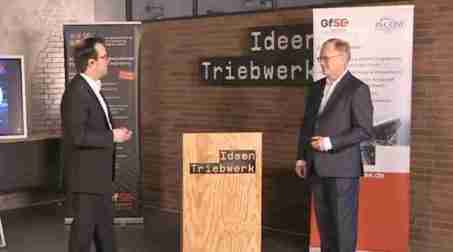
TdSE lecture: AI as a mediator between humans and system models

System modeling has great potential to get to grips with the increasing complexity of product development. However, acceptance in the industry is rather moderate. One of the reasons for this is that a relatively high upfront investment is required, in contrast to classic, text-based systems engineering. In addition, many stakeholders reject the relatively formal notations (whether graphical or textual).
This is where artificial intelligence has enormous potential to mediate between humans and the system model: Recognizing when requirements contradict the system model, finding (and filling) gaps and much more.
In my presentation at the Systems Engineering Day on November 16 in Würzburg, I will explain what this could look like and what we should expect in the short, medium and long term. Below is a brief overview of the content of my presentation.
Meeting at TdSE?
First of all, I'm already looking forward to discussing systems engineering with friends and colleagues again in a few weeks' time at the annual Systems Engineering Day (TdSE) of the GfSE to exchange ideas. If you are also taking part, I would love to meet up with you there!
AI: A companion for MBSE
First of all: This is not the first time I have dealt with the topic of MBSE with AI in this blog. The following two articles in particular go in a similar direction to what I will be covering at TdSE:
AI must be a facilitator, not just an automator
In contrast to the older SE Trends articles, this presentation is about the intermediary role of AI and how we can gradually establish this. In particular, many AI-based tools on the market lack a long-term view. Instead, often only small use cases are supported with AI, such as creating an initial set of requirements (but not maintaining the requirements). Many companies also argue that a purely text-based approach is sufficient to effectively support systems engineering. However, a systematic analysis already shows that the potential is limited.
A purely text-based approach is not enough to break through these limitations of using AI in systems engineering: we need to include a system model in the analysis.
From assistant to agent in 4 steps
In my presentation, I argue that we need a strategy to make AI more than just a helpful automation assistant:
- Stage 1: A common language - A precise exchange between humans and AI requires a common language. The most primitive form of a common language is a glossary, which must be expanded into a complete domain model in the medium term. Here we can use notations such as the SysML or use structures for ontologies.
- Level 2: Relationships - Traceability is essential in systems engineering and enables many other use cases. Unfortunately, many traceability activities are rather monotonous. AI is already being used here in practice. But with a sensible strategy and the combination with complementary domain modelling, we can realize previously unrealized efficiency gains here. Relationships are also essential for the next stage:
- Level 3: Behavior - In almost all complex systems, system behavior is the most important (and most difficult) aspect of development. However, we can only describe behavior formally and correctly if we have a common language and know how the entities relate to each other.
- Stage 4: Specific extensions - With what has been described so far, we have already got a large part of our system under control with the help of AI. From this point onwards, the areas of application will differ depending on the domain and problem. We will incorporate aspects such as parameterization, quality properties and much more into the model as required.
That sounds nice in theory. In the TdSE presentation, I will go into the various subject areas and the AI technologies that are used in these subject areas. I will also describe possible architectures on which an AI-based product development strategy can be based.
Conclusion
Letting ChatGPT go after a few specifications is not enough! We may be able to make one or two activities a little more efficient, but we won't be able to achieve a quantum leap in productivity. In this presentation, I will try to lay the foundation for a long-term AI strategy in systems engineering.
I am currently validating the ideas shown here with industrial customers who use my quality assistant Semiant in use.