200 Updates a Year: How Chinese OEMs Are Streamlining Their Architecture
First off: I have never worked for a Chinese OEM. What is written here is based on two interviews for SE-Trends, private conversations, and research. However, the sources hardly contradict each other, and where they do align, a pattern emerges that has little to do with the usual explanations.
The usual explanations are: cheap labor, subsidies, and stolen technology. They don’t explain why BYD rolled out around 200 OTA packages per year in 2025, while Tesla rolled out twelve to sixteen in China. Nor do they explain why a vehicle priced under $9,000 comes standard with a driver-assistance system. These are the results of architectural design, not labor costs.
Work Ethic in Asia
About „996“ Enough has been written about this: 9:00 a.m. to 9:00 p.m., six days a week. This model violates Chinese labor law and was formally declared illegal in 2021. While this hasn’t made it disappear, it also doesn’t explain the speed of Chinese OEMs: a factor of 1.7 in working hours does not result in a factor of 2.5 in development time.
The more reliable figure is a different one. BYD employs over 120,000 engineers in research and development. Already In the fall of 2024, the figure was around 110,000 of approximately 900,000 employees, while Volkswagen had 59,626 employees in R&D as of December 31, 2023. Since the beginning of 2023 alone, the company has hired 31,800 college graduates, over 61 percent of whom hold a master’s degree or Ph.D., and over 80 percent of whom are working on development projects. A dedicated institute with around 5,000 engineers works on the driver-assistance system. Monthly personnel costs for the Intelligent Driving division alone amounted to approximately one billion renminbi in 2024.
This allows for a tremendous degree of parallelism. If you can test five variants at the same time, you don’t need a perfect preliminary analysis to determine which variant is the right one. German development organizations compensate for a lack of parallelism with preliminary analysis. This is a rational approach as long as engineering hours are in short supply. It only costs time precisely at the point where time has now become a competitive factor.
Added to this is a cultural term that is used critically even in China itself: 内卷, neijuan, usually translated as “involution.” It refers to competition that generates ever-increasing effort without yielding greater results in the end. The price war in the Chinese EV market is considered a prime example there. The median net margin of 33 publicly traded Chinese automakers fell from 2.7 percent in 2019 to 0.83 percent in 2024. Anyone who admires the pace should also take note of the margin.
The order of the questions
Yuchao Luo studied in Germany, did an internship at Bosch in Bamberg, and returned to China in 2017, first to NIO and later to Z-One Software at SAIC. In the Interview for SE-Trends He describes the difference not as a difference in risk awareness, but as a difference in order.
German engineers first ask whether something is compliant and validated. Chinese engineers first ask whether it works and what can be learned from it. The question of compliance comes later—if at all. Yuchao illustrates this using AI-driven development: When a model generates requirements with a 70 to 80 percent hit rate, European teams first ask for proof of correctness. Chinese teams accept the 70 to 80 percent, verify it manually, and correct the rest. People make mistakes too, and a solution for human error has long existed: reviews.
Yuchao quotes a manager at Bosch China with a statement that challenges the German approach to quality from within:
„Even though you've set up your process to ensure a high level of compliance with very strict standards, you have no proof.“
Bosch Manager
The point behind this is: Someone who has sold a hundred units has no statistical proof of quality, no matter how thoroughly the process is documented. Quality in the field is a result, not a process. This argument doesn't hold water for an aircraft manufacturer. But it does hold water for an automaker producing millions of units.
It is interesting to note how the Chinese regulator responded to the same issue. When critics warned that OTA updates could be misused to quietly fix security vulnerabilities, OTA updates were not restricted. Instead, a reporting requirement is in place: The manufacturer reports the contents of an update before rolling it out, and the authority reviews it—a process that can take months. The iteration channel remains open but becomes traceable. The response to the claim that „rapid iteration is dangerous“ was not a ban, but transparency.
Milestones as Learning Points
Dr. Yousef Hooshmand came from Mercedes-Benz and joined NIO in 2022 as Lead Architect for PLM and the development toolchain. In the Interview for SE-Trends He points out a difference in mindset that can prove costly: A milestone is either a binding delivery commitment, regardless of new information, or an intermediate step from which lessons are learned and the course is adjusted. Chinese organizations more often opt for the second interpretation and accept uncertainty as part of the development process.
Those who treat milestones as delivery commitments create an incentive to hold off on bad news until after the milestone. Those who treat them as learning opportunities create an incentive to report them early. Both models are consistent. But only one of them shortens the time it takes to correct the issue.
Yousef does not believe the tool itself is the real obstacle:
„The speed and quality of product development depend largely on whether the necessary data is complete, consistent, understandable, and available across system boundaries.“
His proposal to challenge the “single source of truth” dogma aligns with this way of thinking: “nearest source of truth” based on a “single source of change.” There is a single authoritative location for changes, but multiple systems are allowed to maintain context-specific copies. This is the federated solution to a problem that many organizations attempt to solve in a centralized manner—and fail.
Architecture Without a Claim to Purity
The most insightful technical article on BYD that I've read in recent months is by Vaisakh Venugopal, and it breaks down the BYD's E/E Architecture right down to the hypervisor level. Anyone reading this will quickly see that the German debate over zone architecture versus domain architecture is taking place at a point where BYD has long since made a pragmatic decision.
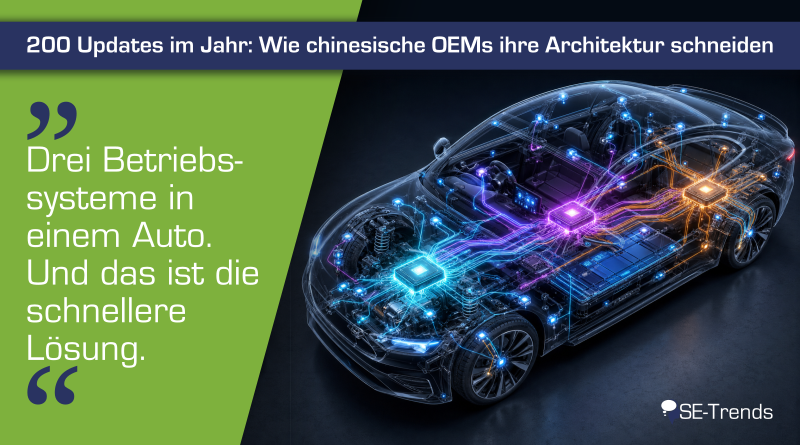
BYD itself summarizes the 2024 Xuanji architecture as „One Brain, Two Terminals, Three Networks, Four Chains.“ At its core is a computer featuring BYD’s own Xuanji A3 SoC, built on a 4-nanometer process and delivering over 700 TOPS—and over 2,100 TOPS in multi-chip configurations. The underlying software setup is particularly noteworthy. BYD runs three operating systems in parallel, separated by a Type 1 hypervisor from QNX:
- BYD OS, a Linux kernel with real-time extensions, serving as an abstraction layer between applications and hardware. This layer is what makes managing 200 OTA packages per year even possible, because dependencies and version information are tracked in one place.
- Android Automotive as DiLink 5.0 in the cockpit, featuring the entire app ecosystem and the AI interface.
- QNX OS for Safety for the drive, brakes, steering, and the execution of driving functions, with strict memory partitioning for ASIL-D.
Tesla, on the other hand, uses a unified Linux stack. This is architecturally cleaner. BYD, however, has opted for the approach that delivers faster and scales more cost-effectively. The share of central computing power currently stands at about 55 percent, compared to 45 percent in edge control units, with a target of around 80 percent centralized by 2028. Centralization will therefore not be implemented all at once.
The chip strategy is just as pragmatic. For its “God’s Eye” driver-assistance system, BYD uses three performance tiers: the Horizon J6M with 256 TOPS for the mass market, the NVIDIA Orin X with 275 TOPS for the mid-range, and its own Xuanji A3 chips at the high end. The Seagull, priced under $9,000, comes standard with the lowest-tier chip. Starting in February 2025, God’s Eye will be standard in 21 of 30 models across four brands. The software framework remains the same across all price ranges; the hardware is configured. This is product line architecture as described in textbooks—yet rarely implemented so consistently in practice.
OTA is an architectural decision, not a feature
The 200 update packages per year are a result of the way the system is structured. BYD updates by domain at different frequencies: infotainment 40 to 60 times per year, driving function algorithms 8 to 12 times, and powertrain and safety-related functions 2 to 4 times. These figures are the true reflection of the architecture. The coupling was separated based on the frequency of changes, not on the organizational structure.
Technically, this is based on specifications found in German technical requirements documents that are rarely implemented with such consistency in German vehicles. Two flash banks operating in an A/B configuration, so that the old partition continues to run while the new one is verified, with automatic rollback in case of failure. Delta compression, which reduces package sizes by 70 to 90 percent and cuts update times from hours to minutes. A unique cryptographic identity key for each vehicle, signed packages, and a verification key stored in the hardware security module.
This structure forms the basis for the data. In 2025, BYD delivered approximately 4.5 million vehicles; about 4.27 million of them transmit data, resulting in roughly 150 million kilometers of training data per day. Companies that have closed this loop improve their driving functions with every car they sell.
The ecosystem has a radius of four hours
In Germany, the supply chain is typically discussed in terms of contract law, whereas in China, it is viewed from a geographic perspective. A “four-hour circle” has emerged in the Yangtze River Delta: Shanghai supplies chips and software, Jiangsu supplies batteries, Zhejiang supplies die-casting machines, and Anhui handles final assembly. All components of an electric vehicle can be sourced within a four-hour drive. In Hefei alone, there are over six vehicle manufacturers and more than 500 suppliers. NIO built its millionth vehicle there in January 2026 at Plant F2.
That’s why proximity is an iterative decision. If you want to change a component, you go there. A design review with the supplier takes a morning instead of a travel request. The traditional German structure spreads the same coordination process across several countries, several time zones, and several contractual levels. In the Analysis of the Platform and Architecture at BYD and VW Here's an example that everyone is familiar with from real-world experience: Installing a larger display can take years through the supply chain.
BYD goes even further and manufactures about 75 percent of its key vehicle components in-house through subsidiaries of the FinDreams Group—ranging from the Blade battery to IGBT modules and silicon carbide, all the way to control units and wiring harnesses. Tesla’s figure stands at around 45 percent. Vertical integration is essential here to enable changes to both the battery and the power electronics within the same development cycle without having to renegotiate two contracts.
To put this into perspective, here’s a figure from the German VC scene: Between 2011 and 2018, approximately one billion U.S. dollars flowed into automotive investments of this kind in Germany, compared to 56 billion in the U.S. and over 30 billion in China. This lead didn’t develop in just three years.
What does not follow from this
It does not follow from all this that the Chinese model is superior. It follows that it is financed differently.
Jochen Siebert of JSC Automotive describes in an interview with GTAI, how part of the cost is paid: Manufacturers settle supplier invoices with checks that are cashed only after six months and paid after another three months. The suppliers' working capital finances the OEM's development. His conclusion is clear:
„I'd say that even BYD isn't making a profit.“
(Jochen Siebert, JSC Automotive
The margins reflect this. A median net return of 0.83 percent does not sustain an economic cycle. In May 2025, the Chinese regulator instructed the industry to end the rounds of price cuts. A market in which the government must step in to halt a price spiral is not a market in equilibrium.
The technical figures should also be interpreted with caution. The 150 million kilometers per day, the threefold increase in iteration speed compared to the industry average, and the cost estimate for the Xuanji A3 are based on company data. They are plausible but have not been independently verified.
Conclusion
The interesting question is not whether German OEMs should adopt the 996 work schedule. It is not the issue for several reasons, and that is not where the gap lies.
The German OEMs’ lag was not caused by short working hours or government intervention. It has entirely technical reasons, such as the system’s architecture. If you divide software based on the frequency of changes rather than along departmental boundaries, you end up with different update cycles per domain. That is precisely what results in 200 updates a year instead of twelve. The order of the questions is the second point. Putting the compliance question before the functionality question prevents the feature from ever reaching the level of maturity at which compliance can be meaningfully tested. The third factor is distance. Physical proximity to suppliers and in-house manufacturing measurably shorten control loops, regardless of any discussion of methodology.
For your own organization, this raises an uncomfortable question: How often per year can each domain in the vehicle actually be updated, and what exactly limits that number? If the answer points to a technical coupling problem, it’s an architectural issue. If it points to an approval process, it is an organizational issue. In most cases, it is the latter, and in most cases, it is the former that is discussed.